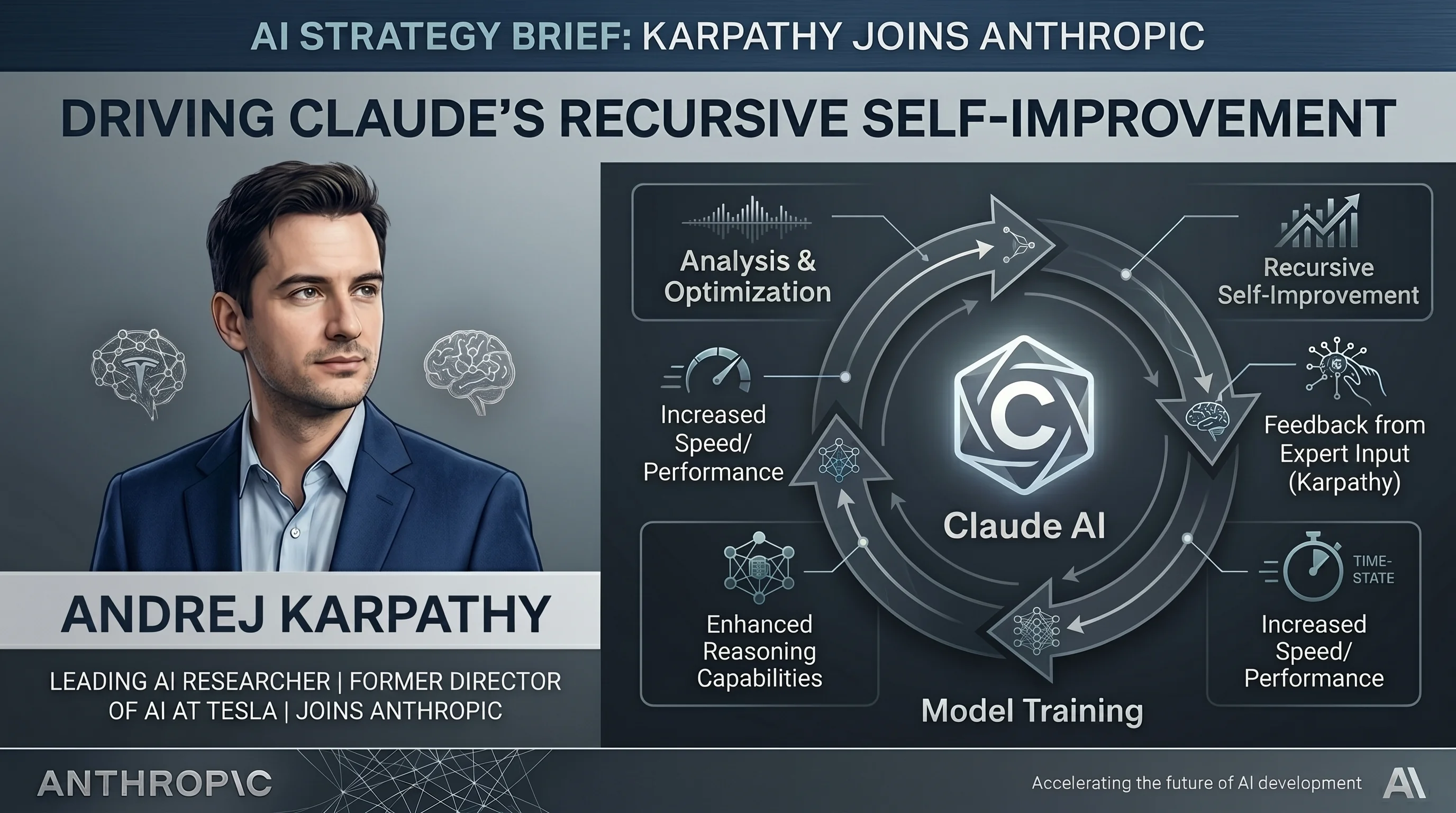
Who Is Andrej Karpathy and Why Does This Hire Matter?
Andrej Karpathy knows how to move fast and think clearly. That's rare in AI.
He co-founded OpenAI in 2015. For years, he was a core voice in AI safety and capability discussions. In 2017 he left OpenAI and went to Tesla to lead Autopilot AI. He built neural networks that let cars see and understand roads in real time. Stayed until 2022.
After Tesla, Karpathy took a different path. Instead of joining another lab, he founded Eureka Labs to teach AI fundamentals and make machine learning accessible. For someone with his credentials, teaching is not obvious. For someone who believes AI literacy matters, it makes sense.
Now in 2026, Karpathy moved from teaching about AI to working on the engine. He joined Anthropic.
What Is His Specific Role at Anthropic and What Does "Using Claude to Accelerate Pretraining" Mean?
Karpathy joined Anthropic's pre training team. That's the team that builds and improves Claude's foundational model — the neural network at Claude's core.
His mandate: use Claude to accelerate pretraining research. Translation: use Claude to make Claude better.
Normally pretraining research works like this. An AI researcher designs an experiment. Writes code. Runs it on expensive computers. Collects results. Analyzes results manually. Does it again. Each cycle takes time and costs money.
Karpathy's mandate: use Claude itself as part of that process. Claude helps design experiments. Claude helps write and review code. Claude helps analyze results. Claude suggests the next experiment. If Claude does all that, research cycles get faster. Faster cycles mean faster Claude improvements.
That's recursive self improvement — using an AI to improve itself.
What Is Recursive Self-Improvement and Why Is This Hire a Signal for It?
Recursive self improvement is one of the most watched inflection points in AI. Simple idea: if an AI system improves itself, it accelerates its own development. That acceleration compounds.
Catch: recursive self improvement is not autonomous. Humans still guide it. But the speed at which humans test ideas, validate assumptions, and iterate gets faster when an AI helps with the grunt work.
For years AI labs talked about it as theoretical future capability. Anthropic just made it explicit: we are hiring the best AI researcher we can find specifically to use Claude to make Claude better. Public statement that recursive self improvement is not theory. It's a current priority.
The Algorithmic Bridge called it "the industry's clearest signal yet that the race toward recursive self improvement is not hypothetical. It's operational."
What Does This Mean for the Near-Term Trajectory of Claude as a Tool?
If Karpathy's mandate works, Claude should improve significantly in the next 12 to 18 months. Faster performance. Fewer hallucinations. Better accuracy on complex reasoning tasks.
For professionals using Claude daily, that matters. Draft legal analysis? Claude gets faster and more accurate, you review less. Financial data analysis? Compliance research? A more accurate Claude means less revision time and more output trust.
Right now most professionals treat Claude as a first draft tool. You generate an outline or summary, then manually review and revise. If Claude gets more accurate, that manual review becomes optional on simpler tasks. On harder tasks, the quality of Claude's first draft improves, so revision time shrinks.
That's the practical implication for non technical professionals.
What Should Professionals Who Use Claude for Work Watch for in the Next 12 Months?
If you use Claude for drafting, analysis, compliance work, or research, watch for these signals over the next year.
Speed: Response time should get faster. Queries taking 30 seconds should take 15 seconds. Matters for interactive work like drafting or revision.
Accuracy on specific tasks: Look for improvement on tasks relevant to your work. Financial analysis? More accurate calculations and fewer document errors. Compliance research? Citations get more reliable.
Fewer hallucinations: AI systems sometimes make up information that sounds plausible but is false. This is hallucination. As Claude improves, these should become rarer. Watch for fewer moments where Claude confidently states something incorrect.
Better edge case handling: Simple tasks improve quickly. Hard tasks improve slower. Watch for Claude handling unusual or complex scenarios better. Where it used to fail, it now succeeds.
| What To Watch For | Timeline | What It Means |
|---|---|---|
| Response time improvements | 3–6 months | Claude gets faster; interactive use becomes more practical |
| Accuracy on specialized tasks | 6–12 months | Claude becomes more reliable for domain-specific work |
| Reduced hallucinations | 9–15 months | Claude requires less manual verification on claims |
| Better edge case handling | 12–18 months | Claude handles unusual scenarios without falling back to generic answers |
Why Transparency on Recursive Self Improvement Matters
Most AI labs don't publicly announce bets on recursive self improvement. It's strategically sensitive. If you're investing in that capability, you don't broadcast it to competitors.
Anthropic just did. Public hire. Public mandate description. Public signal that this is a priority.
That transparency signals confidence. Anthropic believes Karpathy's work will succeed. They're betting publicly on it.
For Claude users: good news. The company is betting on tool improvement and willing to stand behind it.
The practical test is simple: watch whether Claude starts producing cleaner first drafts, better code reviews, and fewer false starts on long reasoning tasks. That is where a research hire turns into a product change.
The Bigger Picture: Where This Fits in the AI Lab Race
The AI lab race is no longer about who trains the biggest model. It's about who improves models fastest. Karpathy's hire is Anthropic's bet that having an elite researcher focus on using Claude to accelerate pretraining means they win that speed race.
This doesn't mean Claude will be perfect. It means Claude will get better faster than you might expect based on the past 12 months of improvement.
For finance professionals, accountants, lawyers, business analysts who use Claude daily, that matters. A 30% accuracy improvement over 18 months means 30% less time on verification and revision. That compounds into meaningful productivity gains.
Sources
Related Articles on Nexairi
Jim Smart is the founder and editor in chief of Nexairi. A Business Intelligence Developer with experience building data systems for Verizon, U.S. Army operations, and enterprise finance teams, Jim spent years turning complex data into decisions that executives could act on — dashboards, forecasting models, and automation pipelines across telecom and government contracting. He founded Nexairi to apply that same clarity to AI: making emerging technology understandable and actionable for the operators, accountants, and business owners who need it most. Jim holds GenAI certifications from the University of South Florida Bellini College of AI and completed Springboard's Data Science Career Track.