Elon's Interplanetary Stack - Part 4 of 7
This series has moved through the silicon layer, the robot payload and the training compute. Part 4 covers the delivery mechanism: Starship. Open the full series hub.
- Part 1: TERAFAB and custom AI chips
- Part 2: Optimus robots and FSD
- Part 3: xAI Colossus in Memphis
- Part 4 (You are here): Starship 2026 and Mars logistics
- Part 5: The energy and grid layer
The chips trained at Colossus and installed in Optimus robots still need a way to leave Earth.
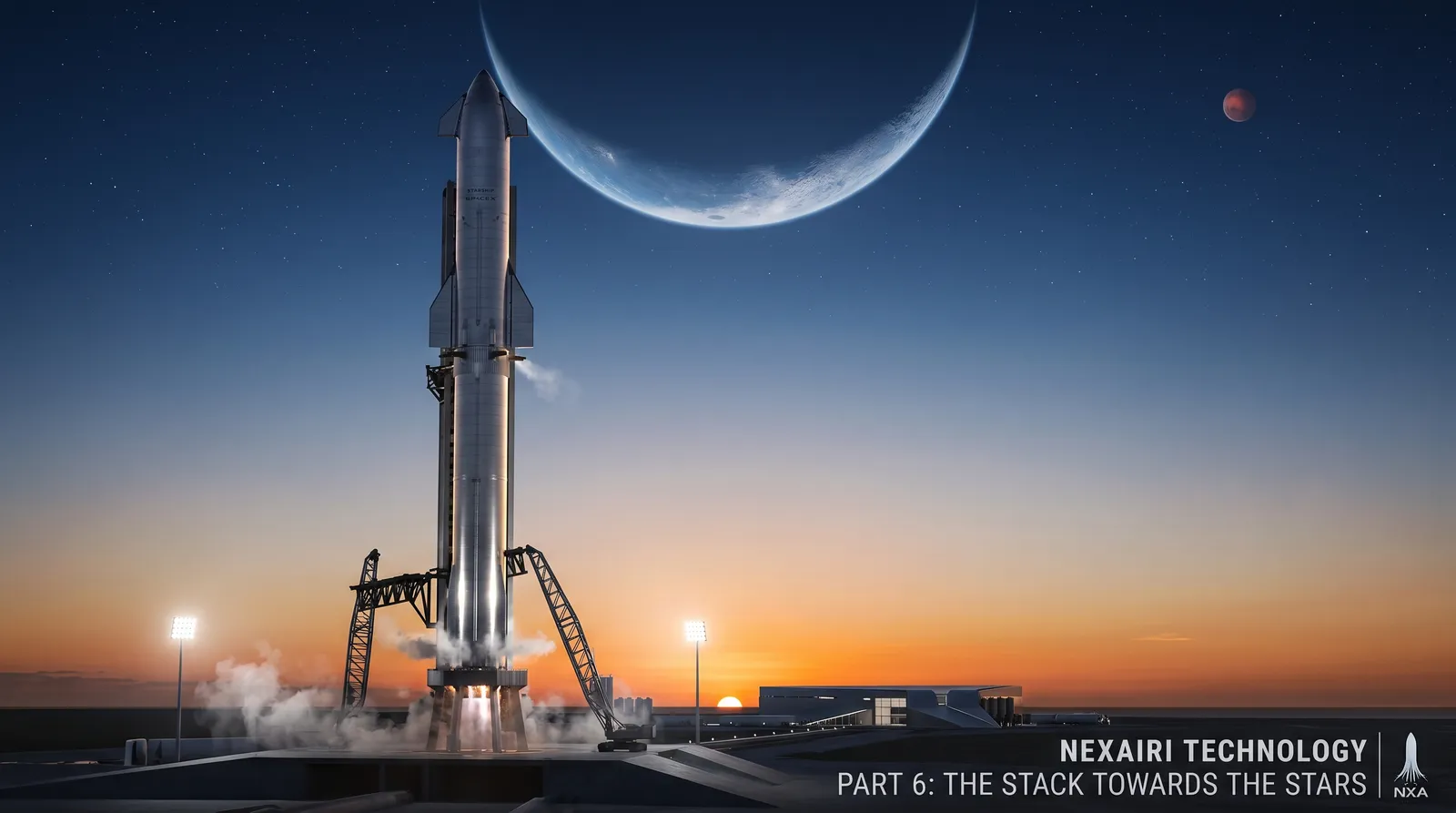
That is Starship's job. TERAFAB (Musk's planned custom chip factory) is the silicon layer. Optimus is the payload. xAI Colossus is the training engine. Starship is the logistics system that turns a robotics and AI strategy into a Mars strategy.
SpaceX is now targeting May 19, 2026 for the first flight of Starship V3, according to Space.com coverage of SpaceX's mission announcement. It will be Starship's twelfth integrated flight test and the first flight of the larger V3 vehicle.
One test flight will not settle the Mars argument. The better test is whether Starship can make mass to orbit cheap and frequent enough that Mars starts to look like industrial logistics instead of a stunt.
Why is Starship the stack's delivery layer?
Starship matters because every layer below it remains Earthbound unless SpaceX makes reusable heavy launch cheap, frequent and operationally routine.
Part 1 argued that custom silicon matters because robots and autonomous systems need dedicated inference hardware. Part 2 argued that Optimus and FSD (Tesla's Full Self-Driving software) are Tesla's real scale bet. Part 3 argued that xAI Colossus is the training engine behind that stack.
But all three remain Earthbound unless SpaceX solves a physical problem: moving large amounts of mass out of the gravity well. Mars does not need one impressive launch. It needs repeated delivery of power systems, habitats, communications gear, propellant equipment, construction hardware and eventually robots that can build before people arrive.
That is why Starship should be judged differently from Falcon 9. Falcon 9 made launch reliable and commercially routine. Starship is trying to make launch industrial.
The series logic
The Interplanetary Stack only works if each layer feeds the next. Chips reduce robot cost. Robots create deployable labor. Colossus trains the intelligence. Starship moves that labor and intelligence to the Moon, orbit and eventually Mars.
What changes with Starship V3 in May 2026?
Starship V3 moves the program from iteration toward operational hardware, but the May 2026 vehicle is still a test article.
Space.com reported that SpaceX is targeting May 19 for Starship V3's debut flight from Starbase in South Texas. The same report says the booster will not attempt a tower catch on this mission because it is the first flight of a significantly redesigned vehicle.
The rehearsal campaign also matters. SpaceX loaded more than 5,000 metric tonnes of liquid oxygen and methane into the fully stacked vehicles during a flight-like countdown on May 11. Multiple reports confirmed the milestone from SpaceX's own update. A few days earlier, SpaceX completed a full-duration static fire of the Super Heavy booster with 33 Raptor engines.
Those are not Mars milestones. They are operational milestones: propellant loading, countdown procedures, pad readiness, engine confidence and vehicle integration. A rocket that is supposed to fly often has to become boring at exactly those steps.
How much can Starship actually carry?
Starship's useful payload target changes planning because 100-ton-class reusable cargo allows missions smaller rockets cannot assemble economically in one launch.
SpaceX's Starship materials describe the system as capable of carrying roughly 100-150 metric tons in fully reusable configuration. Reuters described the fully reusable system as designed to carry more than 100 metric tons of cargo.
That number does more than beat Falcon 9. It changes what engineers can plan. A 100-ton-class vehicle can move pressurized modules, large satellite stacks, lunar cargo, propellant-transfer hardware and heavy construction equipment in a way smaller rockets cannot.
For the series, the more interesting payload is robots. If Optimus eventually becomes useful in construction, inspection or maintenance, Starship is the only Musk-company vehicle designed to move that hardware off Earth in large batches. A Mars base does not start with astronauts planting a flag. It starts with machines, power systems and repeated cargo missions.
| System | Role in the stack | What has to be true |
|---|---|---|
| TERAFAB | Builds or supports custom silicon for robots and autonomous systems | Chip supply has to become cheaper and more controlled than buying general-purpose GPUs forever |
| Optimus | Turns AI into deployable labor | Robots have to become reliable enough for work outside controlled demos |
| xAI Colossus | Trains the intelligence layer | Compute scale has to translate into usable autonomy instead of benchmark gains alone |
| Starship | Moves the system off Earth | Reusable launch has to reach high cadence with predictable cost, safety and turnaround |
Why does cost per kilogram decide Mars logistics?
Cost per kilogram matters because a Mars logistics system needs repeatable mass delivery, not occasional heavy-lift demonstrations from Earth orbit.
Falcon 9 lowered launch cost and made reuse normal. Starship's claim is more aggressive: full reusability, much larger payload and a path to launch cadence that makes mass movement routine. Reuters reported that SpaceX is scouting additional spaceport locations. The company is preparing for a future where Starship could launch thousands of times per year. SpaceX described that future as "targeting thousands of flights per year."
That is the scale needed for Musk's bigger claims. A Mars settlement cannot be supplied by boutique launches. A space-based compute network cannot be built with occasional heavy-lift missions. Even a large lunar cargo architecture needs propellant transfer, depot operations and repeated tankers.
The hard part is that cost per kilogram is not proven by a design target. It is proven by flight rate, refurb time, pad recovery, tanker operations, insurance, regulatory cadence and failure rate. Until those are visible, any precise Starship cost-per-kilogram claim is a projection.
So the best way to read the May 2026 V3 flight is this: it is not the launch revolution yet. It is a test of whether the launch revolution has a credible vehicle.
What does NASA still need Starship to prove?
NASA still needs Starship to prove uncrewed landing, docking, propellant transfer and repeated tanker operations before crewed lander use begins.
NASA says it is working with SpaceX to develop Starship Human Landing System for Artemis missions. The agency describes Starship HLS as roughly 165 feet tall and says SpaceX must perform one uncrewed demonstration mission before crewed use.
The cargo side matters for this series too. NASA says its HLS providers are also developing cargo versions of the landers to deliver large equipment and infrastructure, including rovers and habitats, to the Moon's surface. That is the same kind of logistics problem Mars would require, just closer.
The NASA Office of Inspector General's 2026 HLS report shows why this is difficult. It describes a mission that depends on a Starship propellant depot in low Earth orbit. Tanker flights must build up enough fuel before an uncrewed lander can depart. The report says SpaceX is targeting one tanker flight every six days until the depot has enough propellant.
That is a useful reality check. Starship's promise is not one rocket. It is a fleet choreography: launch, refuel, dock, transfer propellant, depart, land and eventually return. The refueling architecture is not a side quest. It is the system.
Mars logistics start with cargo before crew
Mars logistics begin with accepting that settlement depends on repeated cargo delivery, pre-positioned machines and power systems before astronauts arrive.
The romantic version is one ship leaving Earth. The industrial version is repeated cargo: power generation, batteries, communications, pressure vessels, thermal systems, construction tools, spare parts, food production equipment and robots to assemble what humans cannot safely build on arrival.
Optimus changes the thought experiment. If Tesla can make a useful humanoid robot at scale, Starship becomes more than a crew transport. It becomes a way to pre-position labor. A first uncrewed Mars campaign could send machines that inspect landing zones, unpack cargo, deploy solar and prepare habitats before people commit to the trip.
That is still speculative. Starship has not proven rapid reuse. Optimus has not proven Mars construction capability. xAI has not proven that model scale turns into reliable off-world autonomy. But the architecture is internally coherent: train intelligence at Colossus, run it on custom silicon, put it inside robots and ship those robots with Starship.
What constraint comes after launch cadence?
The next constraint is power because launch cadence, propellant production, robot factories and AI data centers all compound electricity demand.
Starship can move mass, but every layer in the stack consumes electricity: TERAFAB, Colossus, robot factories, launch sites, propellant production and eventually Mars surface systems. A logistics system that depends on methane, oxygen, batteries and compute quickly becomes an energy story.
That is why Part 5 turns from rockets to the grid. If the stack is real, it will not be limited only by software or ambition. It will be limited by power generation, transmission, storage and permitting.
Starship is the hinge between the Earthbound stack and the off-world stack. It is not enough for it to fly. It has to fly often enough that Mars becomes a logistics problem a company can plan around.
That is the revolution SpaceX is chasing in 2026.
Sources
- SpaceX: Starship vehicle overview
- Space.com: SpaceX targets May 19 for Starship V3 debut
- FAA: Final Tiered Environmental Assessment for increased Starship cadence at Boca Chica
- NASA: Human Landing Systems, Starship HLS
- NASA: HLS cargo lander development
- Reuters via Investing.com: SpaceX scouts spaceports as Starship ambitions grow
- NASA Office of Inspector General: Human Landing System contracts report
Related Articles in the Series
Jim Smart is the founder and editor in chief of Nexairi. A Business Intelligence Developer with experience building data systems for Verizon, U.S. Army operations, and enterprise finance teams, Jim spent years turning complex data into decisions that executives could act on — dashboards, forecasting models, and automation pipelines across telecom and government contracting. He founded Nexairi to apply that same clarity to AI: making emerging technology understandable and actionable for the operators, accountants, and business owners who need it most. Jim holds GenAI certifications from the University of South Florida Bellini College of AI and completed Springboard's Data Science Career Track.