Elon's Interplanetary Stack - Part 3 of 7
This series has moved from TERAFAB's silicon layer to Optimus robots and FSD. Part 3 covers the training compute behind the stack. Open the full series hub.
- Part 1: TERAFAB and custom AI chips
- Part 2: Optimus robots and FSD
- Part 3 (You are here): xAI Colossus and the training layer
- Part 4: Starship 2026 and Mars logistics
- Part 5: The energy and grid layer
How Many GPUs Does xAI Colossus Actually Have?
Confirmed: xAI publicly described earlier phases of Colossus with 100,000 GPUs deployed in 2024. Reported: Recent 2025–2026 reporting and investor communications indicate expansion plans toward a 555,000-GPU scale, though final deployed counts will emerge as construction progresses.
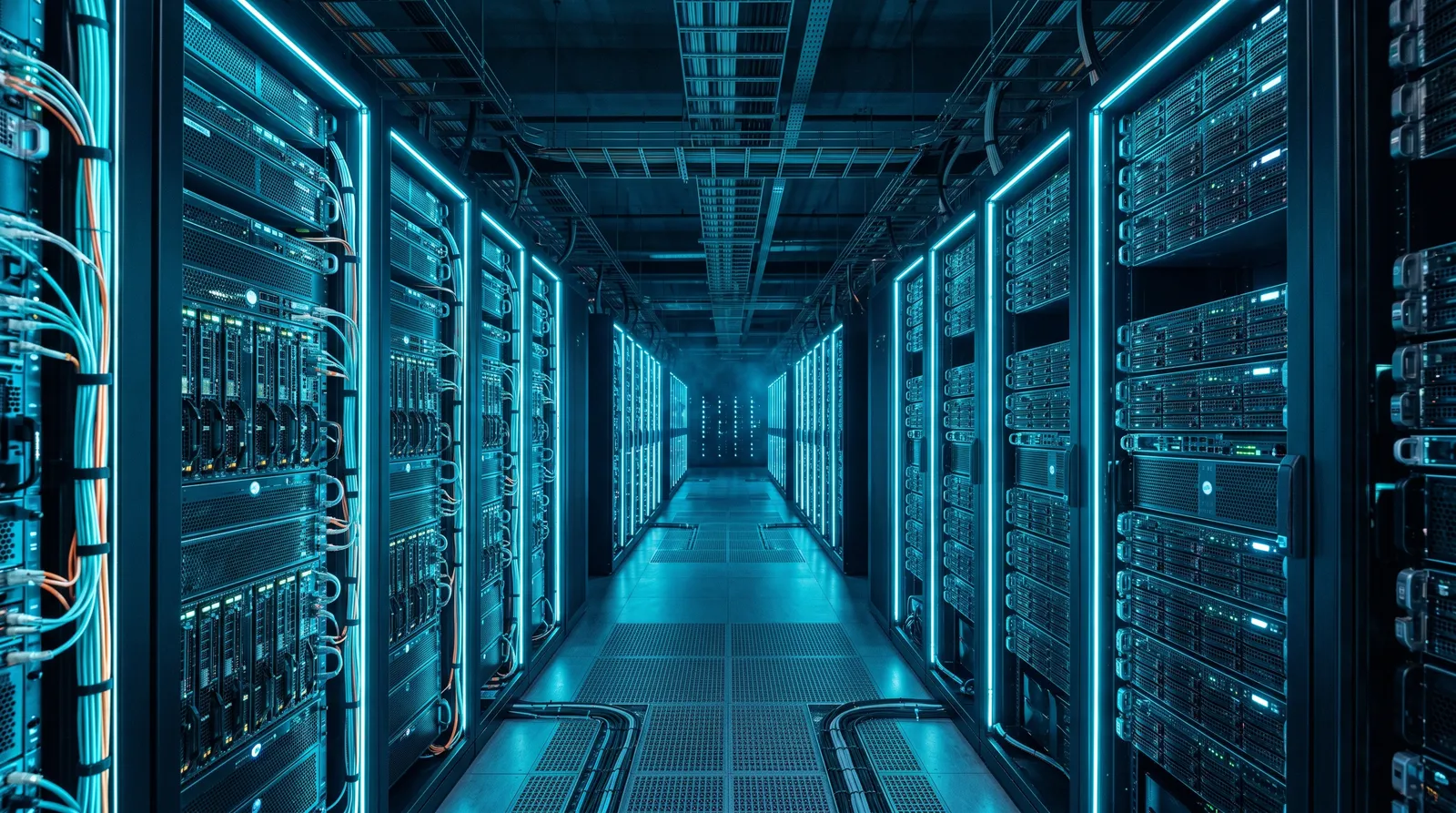
For scale reference: if those estimates hold, the system would be significantly larger than OpenAI's estimated training cluster. Each GPU handles matrix multiplications needed for model training. Estimated: A 555,000-GPU cluster could deliver 15-20 exaflops of theoretical compute, depending on architecture and workload characteristics—though engineering validation of that figure remains incomplete and public sources vary on methodology.
Confirmed: Large-scale GPU clusters like this require high-speed interconnects such as NVIDIA's NVLink or similar fabric (400-900 gigabits per second) to function as unified systems rather than independent machines.
Why Did xAI Build Its Supercomputer in Memphis, Tennessee?
Confirmed: xAI selected Memphis for economics rather than proximity. The Mississippi River region offers abundant hydroelectric and coal-sourced electricity at rates significantly below coastal alternatives.
Confirmed: The region's electricity costs are among the lowest in the US, and Tennessee and Mississippi actively compete for data center investments with tax incentives and infrastructure support.
Estimated: At planned scale, a multi-gigawatt facility would generate significant electricity cost savings versus coastal alternatives, though exact figures depend on power purchase agreements and specific regional rates at time of deployment.
Land costs tell the same story. An acre in Memphis runs about 50 times cheaper than Silicon Valley. xAI could design from scratch without retrofitting existing infrastructure.
What Does It Cost to Run This Scale of AI Infrastructure?
Estimated: A multi-gigawatt facility at planned scale would face substantial annual electricity costs. Industry modeling suggests roughly $700 million to $1 billion per year in power expenses based on regional rates, though actual figures depend on negotiated power purchase agreements and grid conditions.
Estimated: A facility consuming 15+ terawatt-hours annually at regional rates ($40-60/MWh estimated range) would incur major electricity overhead. These costs are recurring annual obligations, not one-time capital expenditures.
Cooling at this scale is a critical engineering challenge. Modern GPUs dissipate 400-700 watts each; sophisticated liquid cooling, redundant systems, and backup power are essential. Cooling failures can cascade across entire facility sections, making reliability infrastructure non-negotiable.
Estimated: Building a data center at this infrastructure scale—including land acquisition, power infrastructure, fiber routing, building construction, and GPU installation—likely runs $15-25 billion based on industry benchmarks. xAI's announced $20 billion investment aligns with this modeled range. By comparison, a 100,000-GPU facility typically costs $2-4 billion, so scaling to 5-6x that multiplies complexity and integration costs in non-linear fashion.
These numbers don't move with venture capital. They move with nation-state budgets or Fortune 10 cash flows or Elon Musk.
| Metric | xAI Colossus (Reported/Estimated) | OpenAI GPT Cluster (Industry Estimate) | Google TPU v5e Pod (Public Disclosure) |
|---|---|---|---|
| Total GPU/TPU Count | 100,000 confirmed (2024); 555,000 planned/reported | 100,000-200,000 (industry estimate) | ~50,000 TPUs (est.) |
| Compute Power (Theoretical) | 15-20 exaflops (estimated; methodology varies) | 3-6 exaflops (est.) | 1.5-2 exaflops |
| Power Draw (Planned) | ~2 GW planned capacity (reported) | 0.5-1.5 GW (est.) | 0.3-0.8 GW |
| Annual Electricity Cost (Estimated) | $700M-$1B (modeled; dependent on power contracts) | $200M-$600M (est.) | $120M-$300M |
| Capital to Build (Estimated) | $20B announced (consistent with $15-25B industry range) | $3B-$8B (est.) | $1.5B-$3B |
Note: All figures above represent reported data, industry estimates, or models. Final deployed specifications and costs may differ as projects progress. Exaflops calculations assume specific architectures and are highly sensitive to software optimization and workload characteristics.
How Does Colossus Fit Into the Broader Technology Strategy?
Confirmed: xAI, Tesla, and SpaceX are operationally integrated under unified leadership. xAI operates as the AI research and training engine.
Interpretation/Strategic: The logical product flow would be: foundation models trained on Colossus → inference optimization for deployment → manufacturing through Tesla infrastructure → real-world deployment in Optimus robots and Full Self-Driving systems. This represents vertical integration of the AI stack.
Strategic Context: Tesla's TERAFAB chip venture and xAI's Colossus infrastructure can be understood as complementary: training infrastructure producing models, and manufacturing capability producing deployment hardware. However, the specific production flows and technical handoffs between these systems remain largely unpublished.
Interpretation: The unified leadership structure suggests this may be coordinated as one integrated system rather than independent companies, though public technical documentation of these connections is limited.
Why Training Infrastructure Scale Matters in 2026
Established Principle: In 2025–2026, larger training clusters enable faster model iteration and can reduce time-to-capability compared to smaller systems. This is a function of hardware parallelization and algorithmic efficiency.
Mathematical Foundation: Training a large language model requires a fixed minimum number of computations (determined by parameter count and token count). More hardware reduces wall-clock time. A 555,000-GPU system would complete the same training work faster than smaller clusters—though the exact speedup depends on software optimization, batch sizes, and interconnect efficiency.
Interpretation/Strategic: If xAI's infrastructure operates at the reported scale and utilization rates, this could translate to speed-to-market advantages in model capability releases and iterative improvements. However, claiming exact multipliers (e.g., "3 times faster") requires engineering validation specific to actual workloads and configurations.
Interpretation: Large training infrastructure represents a competitive advantage in the race for model capability, though it's one factor among algorithm design, talent, and data quality.
The Real Cost of Industrial-Scale AI
Most companies think about AI as software. Build an API. Scale it. Cheaper marginal cost per inference. But Colossus represents the opposite: massive capital infrastructure that doesn't amortize.
Estimated: Daily operational electricity costs for a multi-gigawatt facility run into the millions of dollars. Added to this are personnel, cooling infrastructure, maintenance, and GPU replacement over time. For the infrastructure investment to yield positive returns, models and systems trained on this infrastructure must generate substantial downstream revenue through products (Optimus robots, autonomous driving), licensing, or services. This is a long-term capital bet with significant risk if those products underperform or miss market windows.
Interpretation: AI inference has become increasingly commoditized, with cloud providers offering GPU capacity on-demand. Open-source model fine-tuning has lowered barriers to entry. In this environment, companies seeking competitive advantage may need proprietary training infrastructure to ensure speed-to-capability and model differentiation. This logic explains why companies with sufficient capital are building large training clusters.
The Wider Implication: Infrastructure Scale as a Strategic Barrier
Building infrastructure at Colossus scale requires resources most AI labs cannot access: $15-25 billion capital, multi-decade power contracts at favorable rates, state-level government coordination, and GPU allocation in a supply-constrained market. A handful of companies (Meta, Microsoft, Google, OpenAI with backing) can pursue this. Most AI labs and startups cannot.
This creates a structural divide. Tier-1 labs (those with in-house infrastructure) can train models at will and iterate quickly. Tier-2 companies rent cloud capacity or use shared clusters, incurring per-inference costs and dependency on third-party infrastructure. The difference compounds across product cycles.
xAI's commitment to this scale signals a long-term bet on the economic viability of large-scale model training and downstream deployment (Optimus, Full Self-Driving, autonomous systems). Whether that bet pays out depends on achieving sufficient model capability, deployment success, and revenue to justify the infrastructure cost—a calculation only visible over multiple years.
What Colossus Means for AI Competition in 2026 and Beyond
Interpretation: The AI industry has stratified by infrastructure ownership. Tier 1 labs (OpenAI, Anthropic, Google DeepMind, xAI, Meta) own or control sufficient compute for state-of-the-art model training. Tier 2 companies (Mistral, Stability.ai, others) operate smaller models on cloud or mid-scale clusters. Tier 3 comprises companies using APIs, fine-tuning, or open-source models.
Strategic: xAI's infrastructure commitment places it squarely in Tier 1 and signals that entry to this tier requires massive capital and long-term commitment. Companies cannot "rent" their way into this position via cloud capacity; they must build or receive backing from large capital sources.
Interpretation: This dynamic could accelerate consolidation (large companies building, smaller ones consolidating or exiting) or it could prove temporary if cloud providers achieve cost parity or new architectures change the equation. May 2026 is too early to know which scenario will dominate.
Sources
Related Articles in the Series
- Full series: Elon's Interplanetary Stack
- Part 1: TERAFAB — Tesla's Secret Weapon for AI Chip Dominance in 2026
- Part 2: Tesla Beyond Cars — Optimus Robots and the FSD 2026 Roadmap
- Part 4: Starship 2026 — SpaceX's Launch Revolution for Mars
- Part 5: Elon's Stack Has a Power Problem the Grid Can't Ignore
Jim Smart is the founder and editor in chief of Nexairi. A Business Intelligence Developer with experience building data systems for Verizon, U.S. Army operations, and enterprise finance teams, Jim spent years turning complex data into decisions that executives could act on — dashboards, forecasting models, and automation pipelines across telecom and government contracting. He founded Nexairi to apply that same clarity to AI: making emerging technology understandable and actionable for the operators, accountants, and business owners who need it most. Jim holds GenAI certifications from the University of South Florida Bellini College of AI and completed Springboard's Data Science Career Track.