What Did the GAO Find About the IRS AI Program?
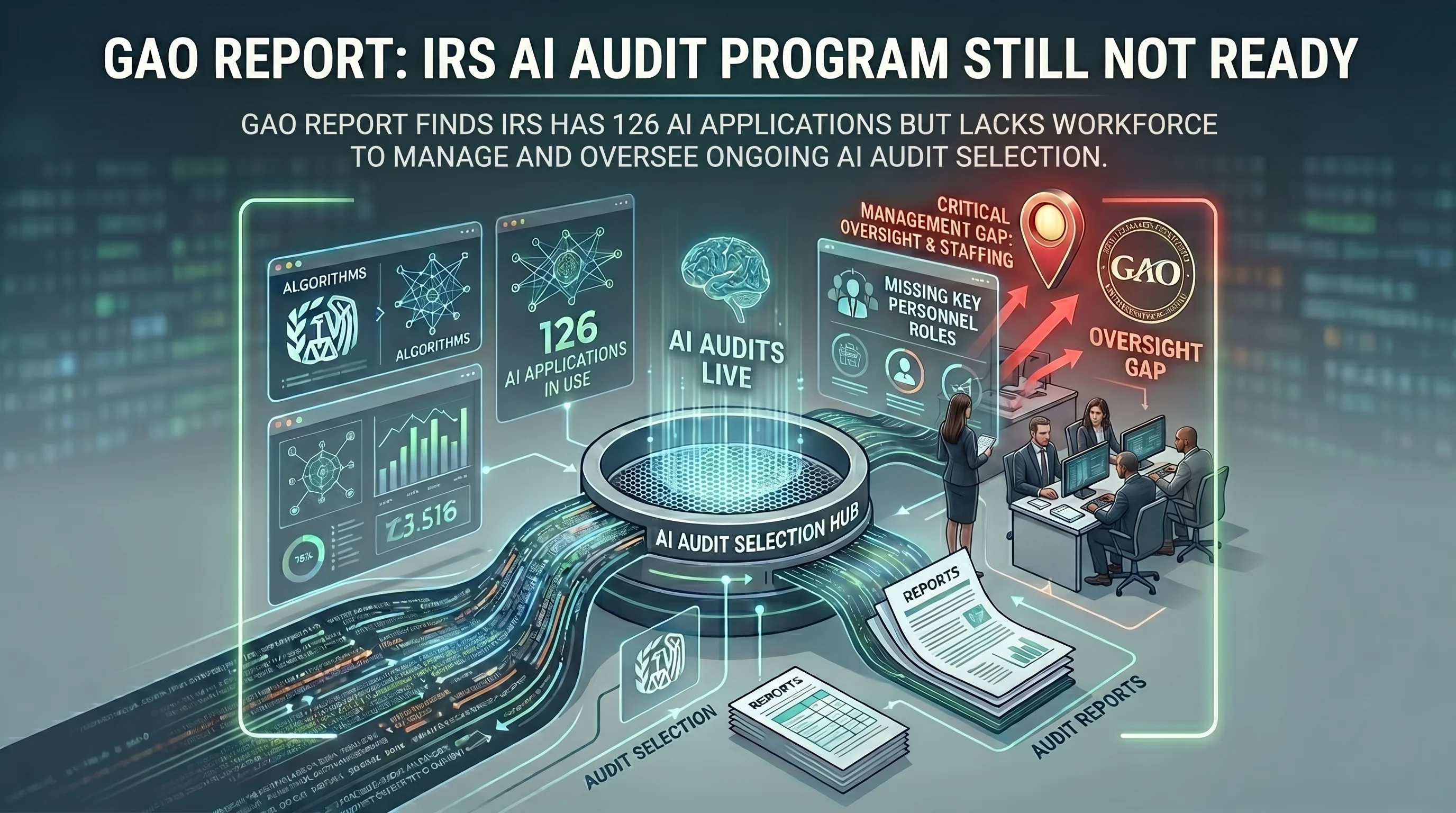
March 2026, the Government Accountability Office released report GAO-26-107522 on IRS artificial intelligence. The findings: the IRS uses AI across 126 applications. The IRS may not be ready to manage them.
Three problems. One: IRS employees lack training in how to oversee and validate AI tools. Two: the IRS doesn't have a complete inventory of where AI is used and what each tool does. Three: the IRS has no plan to fix either before deploying more AI.
The report came out in March. It's May now. Practitioners haven't changed behavior. That's the real story.
Someone is using an algorithm to decide who gets audited. The people supposed to check that algorithm are overworked and understaffed. That's what the GAO flagged.
What Is the IRS Actually Using AI to Do Right Now?
The IRS is not using AI theoretically. It's using AI right now. The 126 applications fall into three categories.
Audit selection: The IRS uses AI to identify returns for audit. Highest stakes AI the IRS runs. Instead of a human analyst deciding "this looks suspicious," an algorithm does. The algorithm learned patterns from thousands of previous audits. If your return matches those patterns, the IRS flags you.
Fraud detection: The IRS uses AI to spot fraud patterns — identity theft, false dependencies, inflated deductions. The AI flags cases early so humans can investigate faster.
Taxpayer services: The IRS uses AI in phone and chat systems. When you call the IRS, an AI might route your call, transcribe your question, or suggest answers to common questions. Some handles forms and filing guidance. Some handles sensitive info like payment arrangements.
All three live. All three making decisions that affect taxpayers and practitioners today.
Why Does the Skills Gap Matter for Practitioners and Their Clients?
When an algorithm makes a mistake, someone has to catch it. If the IRS employee who would catch the mistake is gone, the mistake stands.
The IRS workforce shrunk 25% in the past year. The agency lost experienced auditors, compliance specialists, managers. Replacements don't happen instantly. Many left because they knew more budget cuts were coming. They found work elsewhere.
Now the IRS is deploying more AI with fewer people to oversee it. That's the risk the GAO identified.
For practitioners: if your client gets an IRS notice flagged by an AI algorithm, there may be fewer experienced IRS employees reviewing that flag before action gets taken. Accuracy might be lower. Response timelines might be different. The traditional audit process your clients know may move faster or slower depending on how the algorithm performs.
What Does an IRS AI-Flagged Audit Look Like in Practice?
If your client gets audited by an IRS AI-flagged return, you won't know the AI was involved. The IRS won't tell you. But you can infer it by looking at audit scope and the patterns the IRS asks about.
An AI-flagged audit typically focuses on one pattern:
Pattern 1: Deductions high relative to income. $15,000 home office deduction on $50,000 income. The algorithm notices.
Pattern 2: Business structures common in fraud. Recently created S-corp with unusual distributions. Pattern matching notices.
Pattern 3: Industry and occupation combinations. Your client works in a field where the IRS has seen fraud before and claims deductions typical of that fraud. The algorithm flags it.
Pattern 4: Data mismatches. IRS gets a 1099 showing $100,000 income from Company X. Your client's return shows $80,000. Algorithm catches the inconsistency.
None means your client is actually committing fraud. They're patterns. The difference: humans reviewing patterns manually have context. They understand exceptions. Algorithms don't. Exceptions are just more data points to them.
| IRS AI Application | What It Does | Implication for Practitioners |
|---|---|---|
| Audit Selection | Identifies returns matching fraud patterns | Audits may focus on pattern-based factors, not substance |
| Fraud Detection | Flags suspicious claiming patterns early | False positives may result in extra scrutiny |
| Taxpayer Services | Routes calls, transcribes, suggests guidance | Clients may get incomplete or incorrect AI-generated guidance |
What Should Practitioners Do Today to Prepare?
The GAO report was released in March. It's May now. Change your approach. Three practical steps.
Step 1: Treat all IRS correspondence as priority. Client gets an IRS notice? Respond quickly and thoroughly. Don't wait three months. Don't delegate to a junior. Review personally, understand scope, respond directly. The IRS is understaffed. Fast responses move your clients to the front of the line. Faster resolution means less audit risk.
Step 2: Document client files thoroughly now. Audit lands on an AI-flagged pattern? First defense is complete documentation. Invoices, receipts, contracts, work logs. All of it. AI systems favor returns with clean, consistent data. If documentation is sparse, pattern matching escalates. Build that documentation culture now, before audit review.
Step 3: Brief your clients on what's changing. Most clients don't know the IRS uses AI to select audits. Most don't know the IRS workforce is understaffed. Most have never thought about what either means for their audit risk. Have that conversation now. Explain: (1) AI is selecting audits, (2) the process is different from traditional review, (3) thorough documentation matters more than ever. Clients who understand the environment make better decisions.
AI in Government Enforcement: The Governance Gap
This isn't unique to the IRS. Many government agencies deploy AI faster than they can build governance infrastructure for it. The problem gets worse when budget cuts coincide with AI expansion. More AI and fewer people to check the AI's work.
For practitioners: government decisions affecting your clients — audit selection, tax compliance, eligibility determinations — will increasingly be made by algorithms that are not fully understood by the agencies running them.
Not a reason to panic. A reason to prepare. Thorough documentation, fast response times, proactive client communication. Competitive advantages when algorithms are involved.
The Bigger Picture: IRS AI Isn't Going Away
The GAO's findings aren't a stop sign for IRS AI. They're a speed bump. The agency will likely hire more AI-trained staff, build a better AI inventory, deploy even more AI tools.
By 2027, IRS AI will be larger and more capable than today. The question practitioners should ask isn't "will the IRS use AI?" The question is "how do I help my clients navigate an audit environment where AI is making initial decisions?"
The answer starts with understanding that environment. The GAO report gives you that foundation.
Sources
Related Articles on Nexairi
Free Assessment
Is your firm ready for AI?
A 5-minute governance check for CPA firms using ChatGPT, Copilot or AI accounting software. Get your score and your top gaps — free.
Curated insights from the NEXAIRI editorial desk, tracking the shifts shaping how we live and work.