What Is the OneStream Finance Agentic Layer and What Changed on May 19?
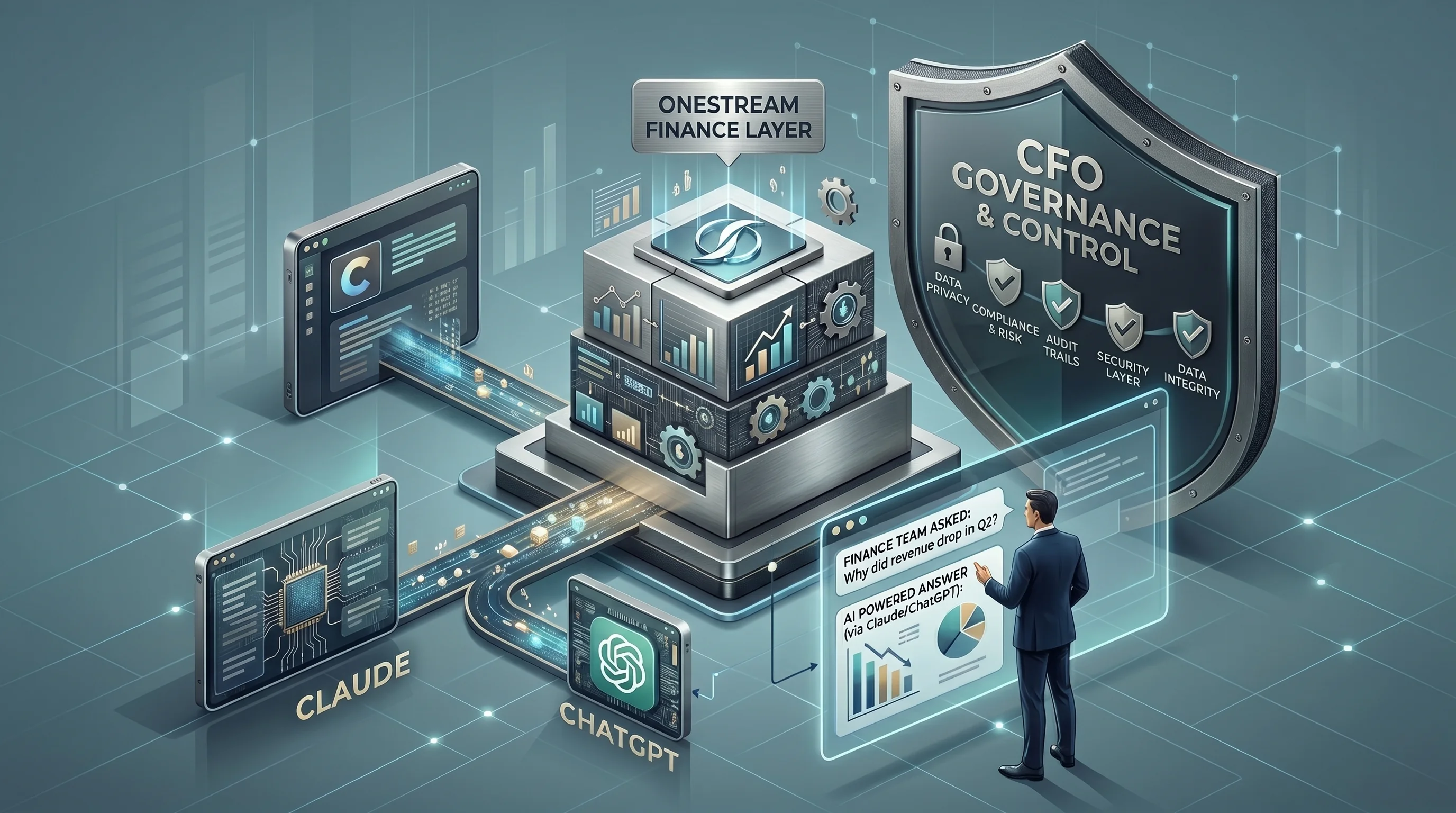
OneStream is enterprise planning software. CFOs use it to build forecasts, close books, analyze variance. On May 19 at its Splash User Conference, OneStream announced the Finance Agentic Layer — a feature that lets finance teams ask Claude, ChatGPT, Copilot, or Gemini questions about their planning data and get answers directly from OneStream's database.
They used Model Context Protocol (MCP) — Anthropic's open standard for AI tools to safely connect to external data. OneStream didn't build a custom API for each AI tool. They built one MCP integration. Any MCP-compatible AI works now.
This matters. For years, connecting AI to company data meant custom API work, vendor risk, months of IT cycles. MCP kills that. It's the universal socket.
How Does the MCP Integration Actually Work?
A finance analyst sits down with Claude. "Why is my revenue down this quarter?" Normally Claude gives a generic answer from its training data. With MCP connected to OneStream, it does something different.
Claude connects through the MCP bridge to OneStream. Reads actual revenue data. Pulls historical variance patterns. Retrieves price, volume, mix drivers. Generates an answer: "Revenue dropped 12% because volume fell 8% and price fell 4%. Accounts and product lines with the biggest variances are X and Y." Claude even pulls supporting visuals from OneStream.
No exporting to Excel. No manual copying. No two-hour pivot table. Claude does it in seconds from live data.
That speed matters for board prep, CEO dashboards, investor calls. Especially investor calls.
Which AI Tools Are Supported and Who Gets Access?
OneStream supports Claude, ChatGPT, Copilot and Gemini. That's the big four finance tools. If your CFO team uses one, you're covered.
Access is role-based. Can you see revenue data in OneStream? You see it through Claude. Only GL accounts? Claude only sees GL data when you ask. Permissions don't change. The AI just respects them.
Different from giving Claude access to a folder where someone accidentally uploaded sensitive data. Your OneStream role structure enforces the boundary automatically.
| AI Tool | Supported | User Requirement |
|---|---|---|
| Claude (Anthropic) | Yes | Claude subscription + OneStream access |
| ChatGPT (OpenAI) | Yes | ChatGPT Plus or Enterprise + OneStream access |
| Microsoft Copilot | Yes | Microsoft 365 Copilot Pro + OneStream access |
| Gemini (Google) | Yes | Google Workspace Gemini + OneStream access |
What Are the Governance Questions Every CFO Needs to Answer Before Enabling It?
The technology is safe. The question is simpler: are you ready for this workflow? Three questions first.
Question 1: Does your team actually use OneStream? This only works if you're a OneStream customer with active planning workflows. Anaplan? Cognos? Not applicable yet. If OneStream, move to Question 2.
Question 2: Who in your organization has OneStream access, and do they use Claude or ChatGPT? The integration only helps people with both. Finance team uses OneStream but no one has Claude? The layer isn't useful. Finance team has Claude for writing but OneStream for numbers? Now you have a reason to connect them.
Question 3: What's your review process if AI generates board-ready output? This is the real governance question. Claude generates a variance analysis. CFO puts it in a board pack without human review. Numbers are wrong. Who's responsible? Define that now. Create a standard: is Claude output reviewed by a manager before use? Flagged as "AI-assisted"? Who signs off on the final numbers?
What Does This Mean for the Broader Direction of Enterprise Finance Software?
OneStream's integration signals a bigger shift. Enterprise software vendors are racing to be MCP-compatible because MCP is the new interface layer between AI tools and company data. CFOs won't choose finance software on "does it work with Claude." They'll choose finance software and expect it works with Claude, ChatGPT, Copilot and Gemini by default.
For practitioners: the finance software you recommend to clients should move toward MCP or similar standards. And your AI governance framework needs to cover AI-to-data connections, not just AI-to-document flows.
The Bigger Shift: From Custom APIs to Open Standards
A decade ago connecting enterprise software to AI meant building custom integrations. OpenAI added Stripe integration. Salesforce added Slack integration. Each relationship required vendor work and IT cycles.
MCP changes that. OneStream publishes one MCP specification. Any AI vendor builds support for it. No custom work. Just follow the standard.
Vendor-controlled ecosystem moves to open standard ecosystem. Better for customers (more choices). Harder for CTOs (more complexity).
Practical implication for finance professionals: by end of 2026, most enterprise finance software will have some MCP integration with AI tools. The question won't be "should we enable AI access to our data?" The question will be "what controls do we set for AI access?"
The better first test is not a full rollout. Pick one narrow use case, such as internal variance analysis, and trace the full path from question to source data to reviewer. If that path breaks, the layer is not ready for board material.
What Should You Do This Week?
If you use OneStream, don't rush to enable the Finance Agentic Layer today. Do this first.
Step 1: Schedule a meeting with IT and your OneStream admin. Review who has OneStream access and what data they can see. Document the role matrix. This is your permission foundation.
Step 2: Talk to finance leadership. Do they use Claude, ChatGPT or Copilot? If not, the layer isn't useful yet. If yes, ask: what financial questions do they ask AI tools today? Variance analysis? Cash flow? Board reporting? These are your use cases.
Step 3: Write one simple governance rule. "Finance team members may use the layer to generate exploratory variance analysis for internal management review. All output sent to board members or external stakeholders must pass CFO review first." Share it with leadership.
Sources
Related Articles on Nexairi
Free Assessment
Is your firm ready for AI?
A 5-minute governance check for CPA firms using ChatGPT, Copilot or AI accounting software. Get your score and your top gaps — free.
Jim Smart is the founder and editor in chief of Nexairi. A Business Intelligence Developer with experience building data systems for Verizon, U.S. Army operations, and enterprise finance teams, Jim spent years turning complex data into decisions that executives could act on — dashboards, forecasting models, and automation pipelines across telecom and government contracting. He founded Nexairi to apply that same clarity to AI: making emerging technology understandable and actionable for the operators, accountants, and business owners who need it most. Jim holds GenAI certifications from the University of South Florida Bellini College of AI and completed Springboard's Data Science Career Track.