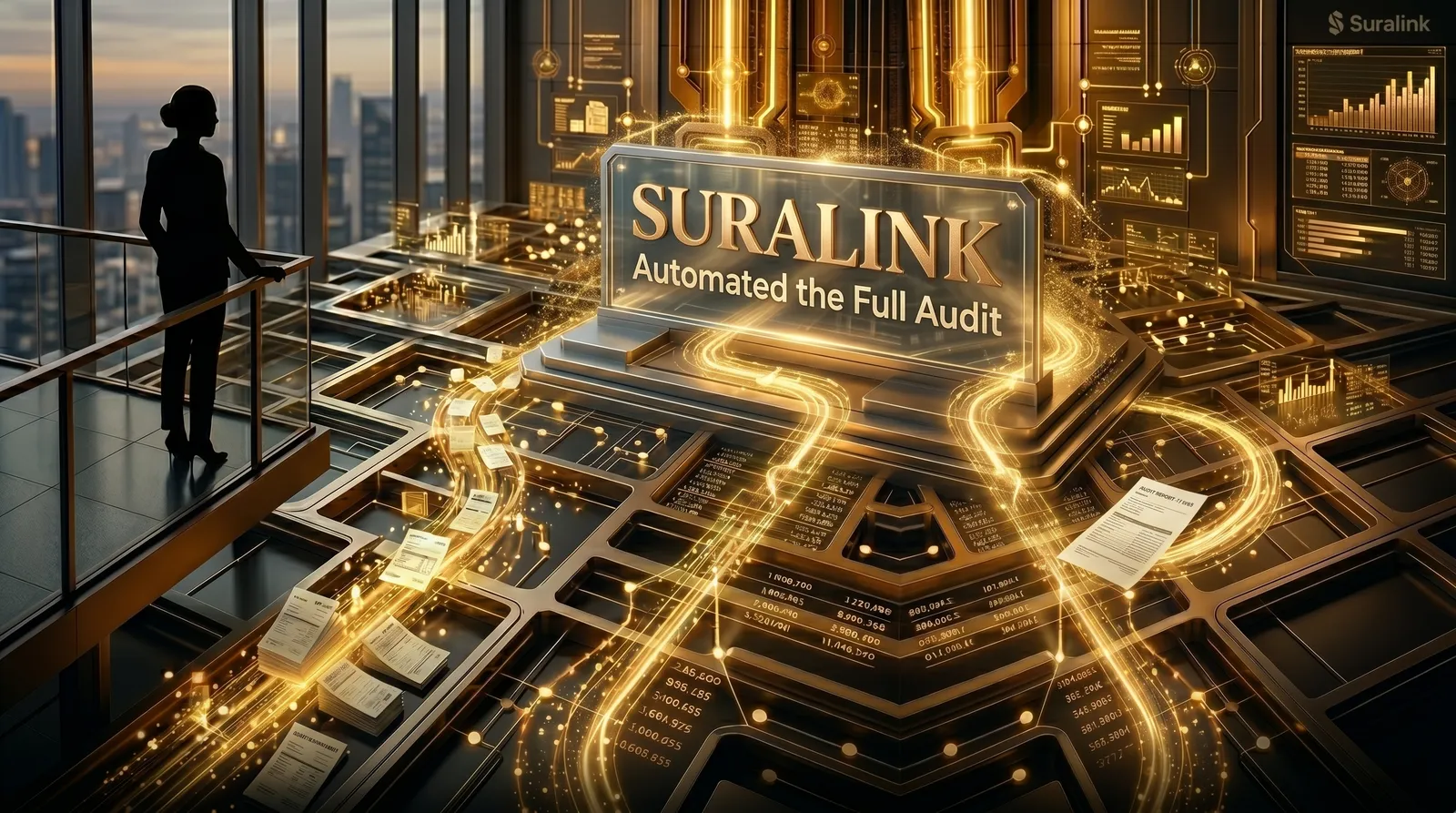
Suralink's new AI workpaper features land at the exact pressure point audit teams already know: turning client files into usable support without losing the evidence trail.
The company launched Workpaper Suite Intelligence on May 5, 2026. The update adds two AI-powered capabilities inside Excel workpapers: Extract Links for pulling structured data from client documents and Link Answers for querying complex files such as lease and debt agreements. The practical question for firms is not whether AI can read a PDF. It's whether a reviewer can prove where the answer came from.
What did Suralink launch?
Suralink launched Workpaper Suite Intelligence, a set of AI capabilities built into Excel workpapers for document extraction and source-linked answers.
According to Suralink's announcement, Workpaper Suite Intelligence is designed for audit and engagement teams that need to turn raw client data into completed workpapers. The company says the release embeds AI directly into Excel workpapers and reduces manual work tied to data extraction and document interpretation.
The two named features matter because they map to familiar audit prep pain. Extract Links captures and structures data from client documents. Link Answers lets teams ask questions of long files, including leases and debt agreements, then return relevant information. For anyone asking what are AI audit workpapers, this is the current answer: AI is moving into the same Excel environment where teams already prepare and review support.
CPA Practice Advisor covered the launch the same day, confirming this is not a general software story drifting into accounting. It is a sector tool update aimed directly at workpaper preparation, review and engagement capacity.
How does AI extraction inside Excel workpapers change audit prep?
The old workflow: staff receive client support, open a PDF, search for the relevant number, copy it into Excel, repeat. All day. Suralink is trying to compress that chain.
Its Workpaper Suite product page says the platform can match and extract data from PDFs, image files, scanned documents and other client support. The efficiency promise is straightforward: less manual copying, fewer data-entry errors, faster work through long documents.
That helps explain how AI works in Excel workpapers. The AI is not replacing the workpaper. It is helping populate and link it. Suralink says Workpaper Suite integrates with Excel-based workpapers and supports modern Excel versions, including Microsoft 365 and Excel 2019+. That matters because most audit teams do not need another standalone AI dashboard. They need less swivel-chair work between client support, request lists and Excel.
The efficiency promise is real but narrow. AI document extraction for auditors can reduce data entry and reformatting. It can also surface likely answers from long agreements faster than a staff member paging through a document manually. None of that means the output becomes audit evidence by itself.
| Workflow Step | Manual Workpaper Process | Suralink AI Workpaper Process | Reviewer Question |
|---|---|---|---|
| Document intake | Staff downloads, opens and tracks support files manually | Client support is linked through Suralink's request-to-review workflow | Is the file complete and current? |
| Data extraction | Staff copies figures from PDFs or scanned support into Excel | Extract Links captures and structures document data inside the workpaper | Does the extracted value match the source? |
| Agreement review | Staff searches leases, debt agreements and other long documents | Link Answers returns relevant information from complex files | Does the answer reflect the whole agreement? |
| Review | Managers retrace staff steps through documents | Answers and data points link back to the original source | Can the reviewer verify the trail quickly? |
Why does source attribution matter for reviewers?
Source attribution matters because reviewers need to verify AI outputs against original evidence before those outputs support audit conclusions.
Suralink's strongest claim is not speed. It is traceability. The company says every data point and answer gets linked to its original source for verification and auditability. That matters. A summary tool can sound confident and still miss the detail that breaks a conclusion. A linked answer gives reviewers a place to start verifying—which is exactly what an auditor needs.
CPA Practice Advisor reported the same source-linking detail in its May 5 coverage. The distinction is worth emphasizing: a link back to the source is not the same as AI completing the audit work. It is AI preparing the evidence path, leaving the judgment to humans.
For audit teams, the review question becomes more specific: how to review AI audit evidence when the evidence started as an AI extraction. The answer should be procedural. Check the linked source. Confirm the value, date, scope and context. Document who reviewed it. Require exceptions to be resolved before the workpaper moves forward.
What should firms document before using AI workpapers?
Firms should document tool scope, file access, output testing, reviewer signoff and exception handling before AI workpapers touch live engagements.
The PCAOB has not written a Suralink-specific rule. It has, however, put technology tools on the regulator's research agenda. The PCAOB's Data and Technology research project says staff are assessing whether guidance, standard changes or other regulatory actions are needed because auditors and preparers are using more technology-based tools.
That regulatory context changes the buying question. Do I need AI workpaper software is not just an efficiency question. It is a supervision question. Before a firm pilots Suralink Workpaper Suite vs manual workpapers, it should define what the tool may touch and where a human must intervene.
- Use case: Which workpapers, client support files and document types are in scope?
- Access: Which staff can run extraction or ask document questions?
- Testing: How will outputs be compared against staff-prepared work before broad use?
- Signoff: Who approves AI-assisted evidence before it supports an audit conclusion?
- Exceptions: What happens when the linked source does not support the answer?
Suralink says Workpaper Suite follows enterprise-grade security standards, including encryption for stored and transmitted data. Firms should still map that claim to their own client data policies, independence rules and engagement documentation standards.
The Firm-Level Review Test
Start with read-only, high-friction work. Leases and debt agreements are logical pilots because Suralink specifically names them and because reviewers can compare the AI answer against a known source document.
Do not start by letting AI drive audit judgment. Start by measuring whether the tool reduces time spent copying, searching and tracing support. Compare outputs against staff work. Document reviewer signoff. Restrict client data access to the same people who would see the workpaper in the normal engagement process.
The best AI audit tools for firms will not be the ones with the broadest claims. They will be the ones that let a partner ask a simple question during review: show me the source.
What comes next for audit technology oversight?
Audit technology oversight is moving toward documentation of how tools are selected, tested, supervised and tied to audit-quality controls.
The PCAOB's May 5 update does not create a new rule for AI workpapers. It does show where the oversight conversation is going. The regulator said it is studying "technology-based tools by auditors and preparers," including how technology innovation affects audit quality. That is directly relevant to source-linked extraction tools.
Audit technology oversight in 2026 will likely be less about whether firms use AI and more about whether they can explain their controls. A firm that pilots AI workpapers with a clear review path is in a stronger position than a firm where staff quietly paste AI outputs into support without documentation.
Suralink's launch is useful because it makes the adoption gate visible. AI can help with document interpretation and evidence preparation. The reviewer still owns the audit file. Firms that understand both parts will move faster without pretending the tool is doing work only a professional can sign off.
Sources
Related Articles on Nexairi
Free Assessment
Is your firm ready for AI?
A 5-minute governance check for CPA firms using ChatGPT, Copilot or AI accounting software. Get your score and your top gaps — free.
Curated insights from the NEXAIRI editorial desk, tracking the shifts shaping how we live and work.