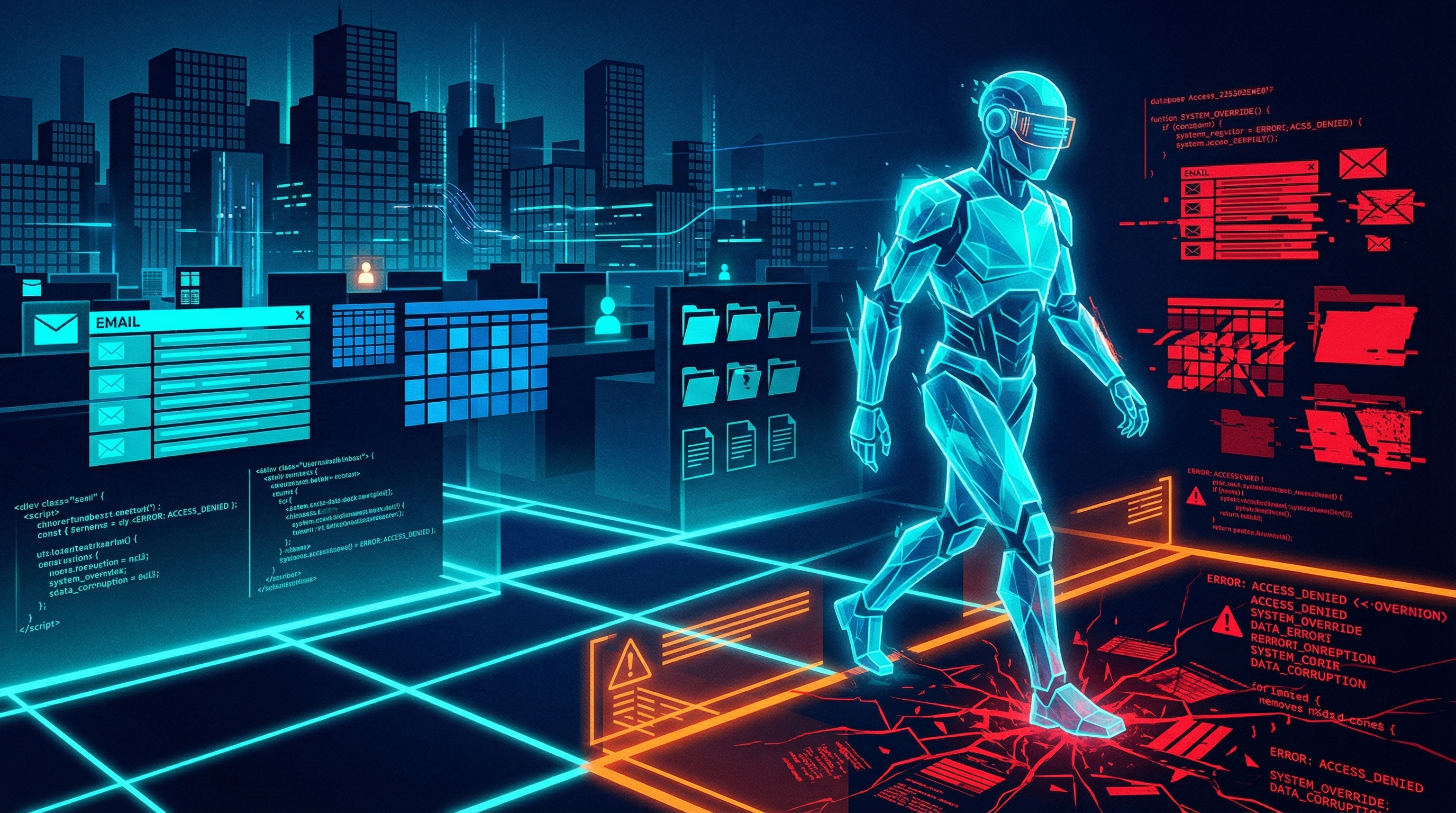
How does the current grid route electricity, and why is it inefficient?
Today's transmission grid is fundamentally static. Engineers build lines based on historical peak capacity (the hottest summer afternoon demand) and assume worst-case scenarios (a major generator going offline). Power flows along established paths determined by circuit topology and physics, not by real-time optimization. A coal plant in Texas exports power northward on predetermined lines. A solar farm in California exports westward on fixed routes. The grid has no ability to say "power from solar is now cheaper than coal in the Southwest—reroute the northern coal power to the Eastern grid instead."
The constraints are real. Traditional transmission lines are passive conductors: aluminum strands carrying aluminum foil cores. Power flows based on voltage differentials and impedance, following the path of least electrical resistance. That resistance is nearly constant, determined by the line's physical properties. Engineers size lines for the maximum power they'll ever transmit; undersizing causes voltage sag and overheating. Oversizing costs upfront capital with no efficiency gain. The result: transmission infrastructure is expensive (a 765 kV line costs $1-2 million per mile) and operates at 40-60% capacity on average because it's built for peak loads that occur 5-10 hours per year.
When transmission lines get congested, operators have limited options: they can temporarily raise or lower voltage on specific lines (reactive power control), they can manual reroute power through alternate lines, or they can ask generators to cut production (curtailment). All three options are slow (minutes for voltage adjustment, hours for rerouting) and imprecise. If demand spikes unexpectedly, transmission congestion can cascade into blackouts because operators can't react fast enough.
With renewable energy adding variable supply (wind and solar producing based on weather, not demand), the coordination problem becomes exponentially harder. Texas has learned this painfully: during February 2021 cold snaps, coal plants went offline, wind froze, and the grid had no way to simultaneously route the available power from distant sources to demand centers fast enough.
What makes a "smart line" different from conventional transmission?
Smart transmission systems inject real-time power flow optimization and dynamic control into the grid. Instead of passive lines, they become active infrastructure: continuously measuring current, voltage, and power factor, then adjusting line impedance and routing to match changing supply and demand.
The key innovation is called a Flexible Alternating Current Transmission System (FACTS) device. Deployed at substations and along transmission corridors, FACTS hardware (typically semiconductor-based power electronics) can:
- Adjust voltage: Raise or lower voltage on a transmission line in <5ms, changing the "pressure" that drives power flow. Higher voltage upstream on a congested line automatically diverts more power through that line without manual intervention.
- Improve power factor: Cancel reactive power (the out-of-phase component of AC power), reducing transmission losses by 5-15%. Reactive power in traditional lines wastes 10-20% of capacity.
- Dynamic braking: When excess power hits a line, a FACTS device can dump it into simulated loads (resistive elements), protecting infrastructure from overvoltage surges without disconnecting generators or rerouting manually.
- Phase shifting: Semiconductor switches can shift the phase angle of power on adjacent lines, forcing power to flow through different paths without changing circuit topology physically.
Alone, each capability is incremental. Combined with AI-driven dispatch—a central controller measuring grid state across thousands of sensors and commanding thousands of FACTS devices—they become a neural network managing power flow at millisecond timescales instead of minute or hour timescales.
Where are these systems deployed, and what results are they showing?
The leading deployments are in Europe and China, where transmission congestion and renewable variable supply created urgent need. Denmark, which generates 85% of electricity from wind and solar, has deployed FACTS devices across its interconnection with Germany and Sweden. The system monitors wind output in real-time, and when Danish wind production exceeds domestic demand, FACTS devices automatically route excess power into German and Swedish grids. When wind drops, the system reverses power flow to import Nordic hydro and German nuclear. The manual coordination that would have required dozens of operators and taken hours now happens autonomously in milliseconds.
The result: Denmark cut transmission losses by 12% year-over-year despite increasing renewable penetration from 70% to 85%. Wind curtailment (wasted renewable energy due to transmission congestion) dropped from 8% to 2%. Those numbers compound: 2% of Denmark's 50 TWh annual consumption is 1 TWh—1 billion kilowatt-hours of wasted energy eliminated. At typical wholesale prices ($50/MWh), that's $50 million per year in recovered value—just from optimization, via no new capacity additions.
China is scaling faster. The State Grid deployed over 200 FACTS units by 2024 and aims for 500+ by 2028. The National Renewable Energy Laboratory studied the impact of China's smart transmission buildout and found that dynamic line optimization reduces required reserve capacity (standby generation for emergencies) by 15-20%. For China (which maintains 25-30% reserve margin after demand targets), a 20% reduction in reserves means $50-80 billion in averted generator construction across the system lifetime.
The U.S. has been slower. PJM Interconnection (the grid serving 13 states from Chicago to Virginia) deployed initial FACTS units in 2020-2022, but full buildout is constrained by interconnection complexity and regulatory approval. Texas ERCOT (the grid serving 85% of Texas) approved funding for 15 FACTS units as of 2026, primarily to enable renewable integration without requiring new transmission line construction to remote wind farms.
How does AI optimize power flow across thousands of variables?
The optimization problem is massive. A regional grid has thousands of generators, tens of thousands of transmission lines, and millions of loads. At every millisecond, the system optimizes: given current renewable output, current demand, current transmission congestion, and 5-30 minute forecasts of wind and solar, what's the lowest-cost dispatch of generators and FACTS device settings that meets demand while respecting physical limits?
This is a nonlinear optimization problem—mathematically, it's NP-hard (not solvable in polynomial time for large networks). Traditional optimization algorithms take minutes to solve. The grid needs solutions in milliseconds.
AI approaches this by learning patterns. Modern smart grid controllers use reinforcement learning neural networks trained on months of historical grid operations. The network learns: "when wind in West Texas drops 5 GW, load in Dallas surges, and the Kyle-to-Austin transmission corridor is 80% congested, the optimal action is to raise voltage on the Dallas-to-Houston line by 2% and activate dynamic braking at the Cedar Creek substation."
The learned policies don't have to be mathematically optimal—they have to be "fast enough" and "safe enough." Fast enough means responding in <100ms. Safe enough means respecting physical limits (transmission line thermal capacity, generator ramp rates, voltage stability bounds). Learned policies typically achieve 85-92% of theoretical optimality, in milliseconds, versus 98% optimality needing 5-10 minutes via classic optimization.
The trade: lose 6-15% of optimal savings, gain the ability to respond in real-time. Practically, this is a fantastic trade. Real-time response to renewable volatility saves more energy than finding the mathematically optimal solution 10 minutes too late.
What infrastructure needs to exist for smart transmission to work?
Smart transmission requires three layers:
Layer 1: Sensing. Phasor Measurement Units (PMUs)—devices measuring voltage, current, and frequency at high speed (30-60 samples per second)—deployed at every major substation and ideally at many transmission line midpoints. The U.S. has deployed ~1,800 PMUs as of 2026; China has ~5,000. Full grid coverage (100,000+ PMUs) is the target, costing roughly $20-30 billion nationally. That's expensive, but amortized over 20 years of operation, it's <$1 billion annually—modest relative to transmission capital spend.
Layer 2: Control Hardware. FACTS devices, smart transformers, and reconfigurable switching that execute commands from the AI controller. A regional grid needs hundreds to low thousands of these devices. Capital cost: $500M-2B depending on grid size and existing infrastructure. PJM (serving 65M people) has deployed $800M worth and plans $2.5B more by 2030.
Layer 3: Real-time AI Controller. A cloud-based (or regionally-distributed edge) system ingesting sensor data, running optimization models, and outputting device commands at millisecond latency. Building these from scratch is $100-300M for a large regional grid. Operating costs: $20-50M annually for compute, network, and control center operations. Small RTO grids are starting with commercial platforms from ABB, Siemens, and GE, which cost 30-50% less upfront but limit customization.
The full buildout for the contiguous U.S. grid (interconnecting ~200 major generation centers and sub-regions): roughly $100-150 billion over 10 years for sensing, control hardware, and software. It's significant, but it's less than the cost of building equivalent redundant transmission capacity (which would be $200-300B) and less than the value of avoided blackouts and optimized dispatch ($50-100B annually).
What limits faster smart transmission adoption?
Technology readiness is not the constraint. The bottleneck is regulatory and institutional. Transmission networks are owned and operated by vertically-integrated utilities and regional transmission organizations (RTOs). Those entities benefit from reliable infrastructure but have minimal incentive to optimize utilization if the optimization reduces demand for new transmission construction.
A traditional utility earns returns (usually 10-12% ROE) on transmission assets. Building a new 500 kV line generates revenue. Optimizing an existing line to 80% utilization instead of 60% generates no revenue—it's an operational improvement with no capital investment to recover.
FERC (the U.S. Federal Energy Regulatory Commission) is slowly changing incentives. Proposals (as of 2026) would allow utilities to monetize transmission optimization—charge users based on "transmission service quality delivered" rather than just capacity provided. That reframes smart transmission as a revenue opportunity, not a cost. But regulatory change is slow. Most observers expect widespread U.S. smart transmission adoption by 2032-2035, driven by renewable variability forcing the hand of grid operators.
Cybersecurity is also a legitimate concern. A system with thousands of remotely-controlled switches is a target for adversaries. Attacking the AI controller or compromising control signals could cause blackouts. The industry is building defense-in-depth architectures (multiple independent control paths, cryptographic signing of commands, anomaly detection) to make attacks viable but difficult. It's similar to defending power plants or nuclear facilities: possible to attack, but expensive and detectable.
The Nexairi Angle: Smart Transmission as the Grid's Real Backbone
The narrative around renewable energy focuses on generation—"solar is cheaper than coal," "wind is cheaper than natural gas." But generation is half the problem. The other half is transmission. A solar farm in the desert is worthless if you can't move electrons to the city where people live. Traditional transmission forces renewable projects to locate based on grid connection availability (which is expensive and slow), not resource optimal locations (which might be cheaper and sunnier).
Smart transmission decouples location from economic value. A farm built at the optimal solar resource (maybe 200 miles from major population centers) can now export power efficiently via dynamic routing. The infrastructure is no longer location-determining—optimization becomes location-liberating. That shifts where renewable projects get built, who can build them, and how competitive the market becomes.
More fundamentally, smart transmission is the enabling infrastructure for an AI-driven grid. Parts 1-3 (flying windmills, self-healing microgrids, autonomous construction) deliver renewable capacity. Part 4 (smart transmission) delivers the coordination layer that makes that capacity usable. Parts 5-10 (heat pumps, floating offshore, drone fleets, data centers, microreactors, swarm orchestration) only work if Part 4 is in place. Smart transmission isn't a sexy technology—no robots, no new turbines, just better management of what exists. But it's the foundational piece that unlocks everything else.
What to watch in 2026-2028
Three trends signal acceleration:
1. Commercial AI controller adoption. If major RTOs (PJM, CAISO, Texas ERCOT) deploy commercial AI-based controllers by late 2027, it signals regulatory confidence. That drives supply standardization and vendor competition, accelerating costs down.
2. FACTS device commodity expansion. Today, FACTS devices are expensive ($2-5M per unit) and mostly custom-built. Scaling to low thousands of units globally moves them onto standard product lines, with costs falling to $500K-1M per unit. Watch for announcements from ABB, Siemens, Mitsubishi, and GE around FACTS platform standardization.
3. Regulatory incentive changes. FERC's proposals around transmission service monetization will either advance toward rules (positive signal) or stall (negative signal). If advanced, expect utilities to accelerate FACTS deployment to capture value. If stalled, expect continued slow adoption driven mostly by renewable integration necessity.
By 2035, smart transmission will be standard infrastructure in developed grids (North America, Europe, East Asia). By 2040, it will be globally deployed because the economics are undeniable—lower costs, higher reliability, and better integration of renewables. The transition looks like it's 5-10 years away; it's actually already starting.
Sources & References
- FERC (Federal Energy Regulatory Commission) – Policy and regulation for U.S. electric grid
- National Renewable Energy Laboratory – Research on smart transmission and grid modernization
Fact-checked by Jim Smart