Key Takeaways
- Neural interface technology (DARPA N3, Neuralink) is advancing faster than most people realize. Consumer adoption by 2036 is speculative but not impossible.
- AI-generated sports commentary is already live in 2026. By 2036, AI narrators could learn your exact preferences and narrate personalized broadcasts in real-time.
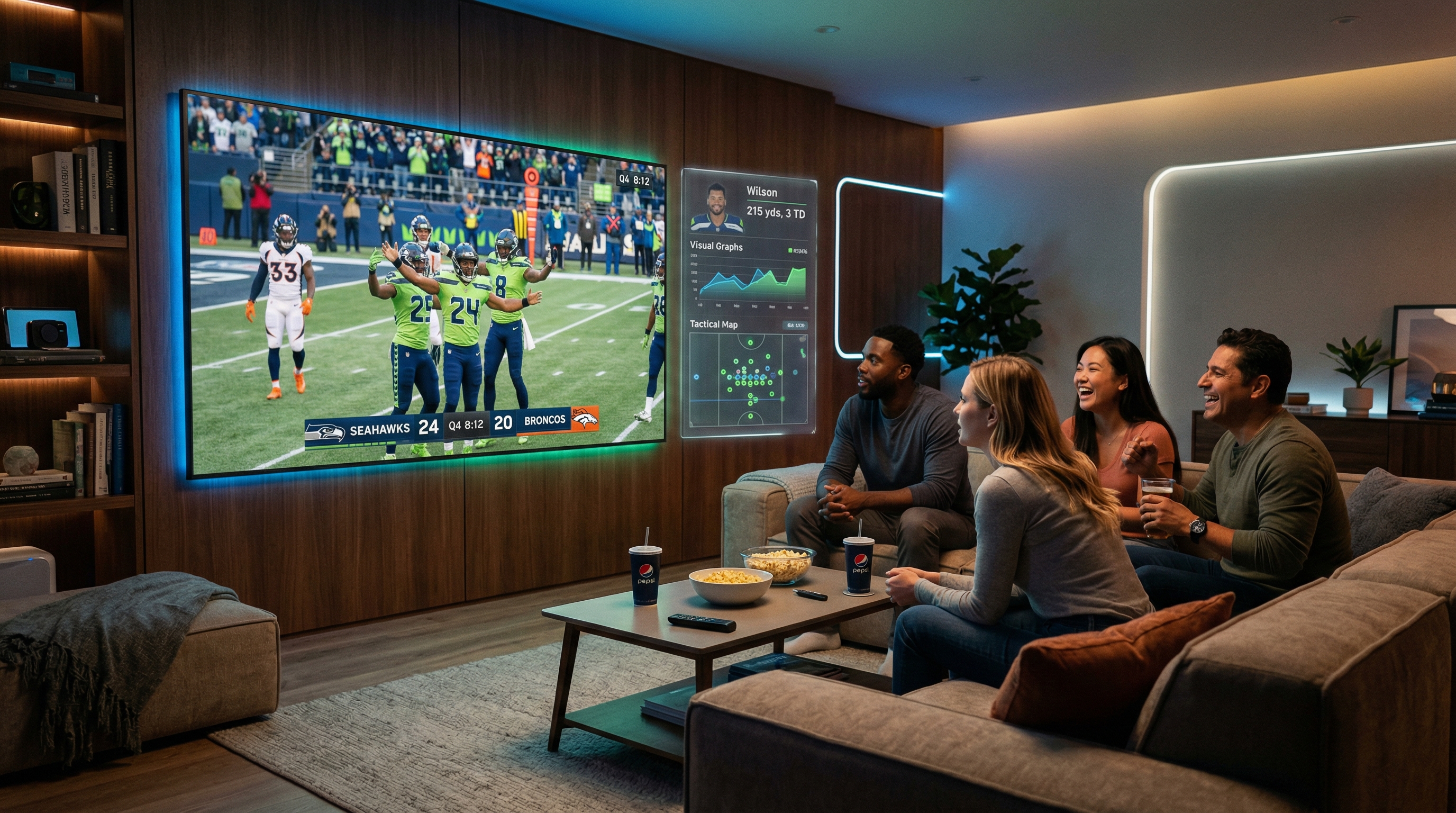
- Hyper-personalized sports viewing—where every fan watches a different game—could erode the shared cultural experience that makes sports binding.
- Codec avatars and digital athlete rendering are technically possible today. The barrier isn't technology; it's licensing and consumer acceptance.
- The real question isn't "will this be possible?" It's "should we build it this way, and who gets to decide?"
What If Fans Watched Sports Through Brain Implants?
DARPA and Neuralink are developing non-invasive brain-computer interfaces targeting 2028–2036 consumer availability, making neural sports viewing technically plausible.
Neural interfaces sound like science fiction, but the research is real. The Defense Advanced Research Projects Agency is actively funding the N3 program—Next Generation Nonsurgical Neurotechnology—designed to deliver non-invasive brain-computer interfaces by 2028–2030. Neuralink, the company founded by Elon Musk, has already conducted human trials. By 2036, early-adopter fans might experience sports not on a screen, but directly in their nervous system.
Here's how it could work: Instead of watching a 2D broadcast on your TV or phone, a neural interface could let you feel the game. Not just see the play, but experience the acceleration of a sprinting receiver, the rotational forces on a pitcher's shoulder, the spatial awareness of a basketball player reading the court in real-time. The research exists. Brain imaging shows that sports fans light up mirror neurons—the same neurons that fire when we perform an action. A neural interface could amplify that signal 100-fold.
The timing isn't assured, but the trajectory is clear. DARPA's N3 program is publicly funded and documented. Neuralink is recruiting trial participants right now. By 2036, we could have working prototypes in affluent early-adopter communities. The question then becomes: do sports fans actually want to experience a game this way? And more pressingly, would this create a two-tier fandom—neural interface users in one reality, traditional TV viewers in another?
Can AI Commentary Systems Narrate Sports Better Than Humans?
AWS and Stats Perform already deploy AI narrators in 2026 broadcasts. By 2036, LLM-powered AI commentary will understand narrative, emotion, and viewer preferences beyond statistics.
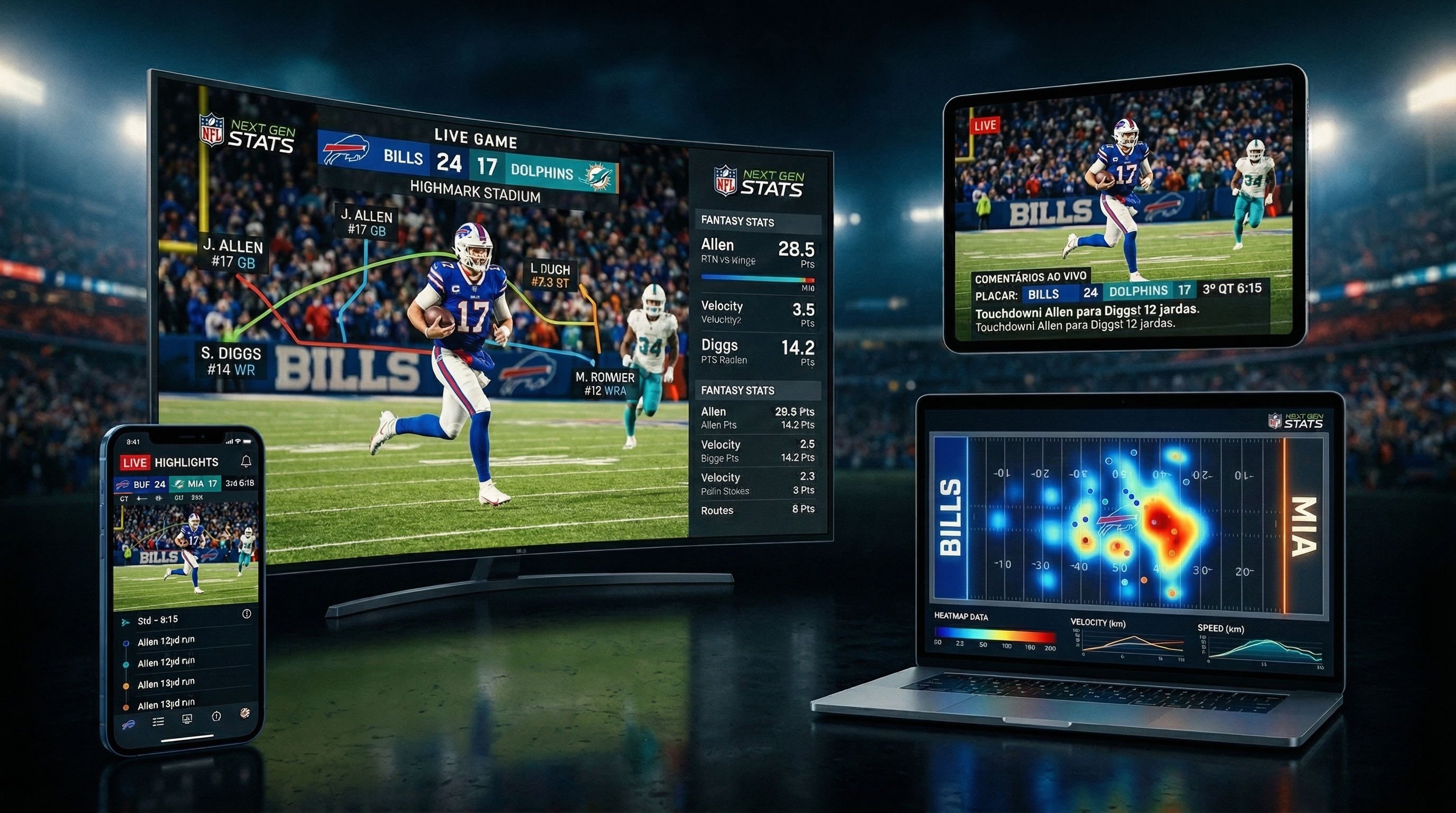
AI-generated sports commentary is not waiting for 2036. It's here now. AWS and Stats Perform are deploying AI narrators in real-time broadcasts, fantasy sports overlays, and streaming platforms right now in 2026. The systems currently sound robotic and statistical, but they're improving at an accelerating rate.
By 2036, this problem is solved. Large language models—the same technology powering conversational AI—will have absorbed years of sports commentary, analysis, and storytelling. An AI narrator of 2036 won't just recite statistics; it will understand narrative arc, emotional beats, and what makes a game meaningful. More importantly, it will know your preferences.
Imagine an AI commentary system that learns you're a fan who loves defensive strategy over high-scoring games. When your team plays, the AI prioritizes explaining the chess match on defense, highlights the read of the quarterback pre-snap, and breaks down why the cornerback's positioning was perfect. Meanwhile, your friend watching the same game hears an AI commentary track optimized for offensive playmaking and highlight reel moments. Same game. Two completely different narratives. The technology to do this exists today. The barriers are just scale and real-time processing.
The deeper implication: by 2036, sports broadcasting moves from a one-size-fits-all experience to a radically personalized one. Part 6 of this series explored AI directors creating custom broadcasts for individual viewers. AI commentary is the next frontier. Your narration, tuned to you, in real-time, by an AI that knows your team loyalty, your tolerance for technical jargon, and whether you want jokes or pure analysis.
What Happens When Every Fan Watches a Different Game?
Personalized broadcasts threaten sports' core identity: the shared experience. Fragmented narratives destroy the water cooler effect that historically unified fan communities.
Here's the uncomfortable question that emerges from Parts 1 through 7 of this series: If every fan can customize their broadcast—choosing camera angles, commentary tone, commentary language, even which players the AI narrator emphasizes—do sports still function as shared cultural experience?
Sports have always been about community. Football on Sundays. March Madness office pools. The "water cooler" effect, where colleagues bond over last night's game because they all watched the same broadcast and saw the same moments. Part 7 examined how sports fragmentation across streaming platforms (Apple, Amazon, Netflix) is already splintering audiences. Part 8 speculates about fragmentation at the individual experience level—not just different platforms, but different broadcasts of the *same game*.
Picture this: a Lakers fan and a Celtics fan watch the same playoff game, but Lakers fan hears an AI narrator emphasizing Lakers' strengths while Celtics fan hears one emphasizing Boston's defense. Same play. Different stories. One fan hears "clutch defense." The other hears "blown coverage." Over a decade, this kind of split fragments fandom into echo chambers where each fan sees what their AI wants them to see.
This is happening on social media already. Sports Twitter is often two incompatible conversations happening in parallel feeds. Imagine if the broadcast itself reflected that. The shared experience—the thing that has historically unified sports fans across geography and background—would evaporate.
Codec Avatars and Digital Athletes: The Choice Problem
Epic Games' codec avatars enable real-time digital rendering of athletes today. By 2036, licensing barriers dissolve, allowing AI-augmented perspectives and ghost overlays of historical players.
Epic Games and Unreal Engine have developed technology called codec avatars—photorealistic, real-time digital renderings of people. These aren't pre-rendered or delayed. They're generated live from minimal input data, capturing motion, expression, and spatial presence. The technology exists today. By 2036, the barriers are solved: bandwidth, processing power, and consumer familiarity.
Here's a speculative scenario: A fan wants to watch a game, but they'd prefer to see it from a retired player's perspective—say, a former center's spatial awareness of the court. An AI system reconstructs the game through codec avatar modeling, showing the live action from that historical player's point of view, with motion capture data informing how that player would likely move and read the game. Not a full substitution, but an AI-augmented perspective layered on top of the actual broadcast.
Or: a younger fan has never seen prime LeBron play. By 2036, codec avatars could render a "ghost" of LeBron in his prime overlaid on the current game, showing how he would hypothetically move or position himself on that court. Educational, entertaining, and technically feasible.
The legal barriers are real—athlete rights, consent, compensation—but not impossible. By 2036, leagues might strike deals. Retired players could license their codec avatars. Sports viewing moves from something you just watch to something you help design.
The Fandom Identity Crisis of 2036
Sports fandom creates belonging through shared narratives. Radical personalization erodes the social glue that historically unified fan communities across geography and background.
Sports fandom isn't just about watching games. It's about identity. People signal their tribe through jerseys, hats, and the teams they publicly support. Fandom creates belonging and shared meaning.
Here's the risk: if sports viewing becomes radically personalized, what happens to fandom as identity? If everyone's broadcast is optimized for their individual preferences, the shared signals of fandom erode. You can't bond with a stranger over "how did you feel about that call in the third quarter" if you didn't see the same call or heard different AI commentary about it.
Sports sociologists have documented that fan communities form around shared narratives. The controversial call that everyone is still arguing about. The upset playoff loss everyone witnessed together. The comeback everyone was stunned by. These are the moments that bind fans. If those moments are fragmented—each fan experiencing a different version, a different AI narrative, a different emphasis—the social glue dissolves.
By 2036, sports leagues may face a choice: do they prioritize revenue from personalized, premium viewing experiences, or do they protect the shared experience that makes sports culturally significant? They probably won't choose consciously. The technology will just drift toward personalization, and the shared experience will quietly fade, replaced by billions of isolated, optimized individual experiences.
The Regulatory Reckoning: Who Gets to Build This Future?
EU's Digital Services Act sets precedent for regulating addictive tech. By 2036, neural interface safeguards will emerge—but likely after behavioral patterns are already locked in.
Neural interfaces raise profound ethical questions that regulators are already starting to address. The European Union's Digital Services Act—enacted in 2024, effective in 2025—sets a precedent. Platforms must disclose algorithmic recommendation mechanisms and avoid "dark patterns" designed to trap users in addictive loops.
A neural interface that directly stimulates brain reward circuits is orders of magnitude more powerful than an algorithmic feed. If an AI narrator, combined with neural stimulation, can manipulate a sports fan into addictive viewing patterns—making sports watching more compelling than sleep, food, or social interaction—that's not entertainment. That's neurotechnology warfare.
By 2036, regulation will likely arrive. Governments may require:
- Neural interface transparency: Disclosure of which brain regions are being stimulated and why.
- Addiction safeguards: Limits on variable-reward scheduling designed to maximize engagement at any cost.
- Fan choice: Options for "neutral" neural broadcasts and AI commentary tracks that don't optimize for engagement metrics.
- Data protection: Neural data (brain signals) treated as the most sensitive personal information, subject to strict GDPR-equivalent rules.
The question is timing. Will these guardrails come before or after neural sports interfaces reshape fandom? History suggests after. Social media regulations came years after social media reshaped society. The same will likely happen with neural interfaces. By the time regulation arrives in 2032–2034, the behavioral patterns will already be formed.
The Speculative Layer: Why This Matters Beyond 2036
Everything in this article is speculative. Neural interfaces, codec avatars, AI narrators that truly understand fan psychology—these are possible, but far from certain. The technology trajectories are real (DARPA, Neuralink, AI research), but consumer adoption, regulatory environments, and business model decisions could easily push back timelines or shift the form these technologies take.
But here's what's not speculative: technology always trends toward personalization and optimization. Sports broadcasting has already fragmented across platforms (Part 7). Personalized viewing experiences are already here (Part 6). AI systems are already analyzing sports (Part 2). We're not facing a cliff edge in 2036; we're on a slope, and we've already started sliding.
The real question isn't "will this happen?" It's "what do we want to happen?" Right now, choices are being made by engineers, product managers, and league executives—often without conscious debate about the downstream effects on sports culture. By 2036, those choices compound. The shared experience might not disappear because of one technology; it disappears because of a thousand small decisions, each individually rational, that collectively fragment sports fandom into isolated, optimized experiences.
The future of sports viewing depends less on what's technically possible and more on what we collectively choose to build and protect. Do we want sports to remain a shared cultural experience, even if less personalized? Or do we optimize for individual experience, even if it means losing the water cooler, the tribal bonding, the sense that everyone watched the same game?
Do We Actually Want This Future?
These technologies will likely be built regardless of preference. Right now is the moment to debate guardrails and decide what we want to protect about sports culture.
This entire series has been speculative. Parts 1 through 7 explored the technology trajectory: data capture, AI production, spatial computing, personalization, immersive venues, AI directors, and business fragmentation. Part 8 synthesizes those trends into a 2036 scenario and asks whether we've been building something worth having.
The uncomfortable truth is that many of these technologies will be built regardless of our preferences. Neural interfaces are being researched by well-funded organizations. AI commentary is already deployed. Codec avatars are technically feasible. The market pressures are overwhelming.
But that doesn't mean we're passive. Right now—in 2026, while these technologies are still speculative—is the moment to ask difficult questions. What guardrails do we need? Should neural interfaces be allowed in sports viewing at all, or are certain brain regions off-limits? Should leagues be required to offer "neutral" AI commentary options alongside personalized ones? Should sports broadcasting be treated as a cultural utility, protected against algorithmic fragmentation?
The 2036 sports viewing experience isn't predetermined. It's the sum of thousands of decisions happening right now—at DARPA, at Neuralink, at AWS, at your favorite sports leagues. The future depends on what we protect and what we prioritize.
Will sports in 2036 still bind us together, or will we each watch our own perfect game, alone?
Sources
- DARPA: Next Generation Nonsurgical Neurotechnology (N3)
- Neuralink: Neural Interface Research
- AWS Sports Solutions: AI Commentary and Analytics
- Stats Perform: AI Commentary Systems
- Unreal Engine: Digital Humans and Codec Avatars
- NIH: Neural Basis of Sports Fandom
- EU Digital Services Act: Algorithmic Transparency and Platform Governance
- NIH: Technology and Behavioral Addiction
Related Articles on Nexairi
Fact-checked by Jim Smart