Key Takeaways
- Apple Vision Pro and Meta Quest spatial platforms are the prototype for post-screen sports—immersive 360-degree environments where you're positioned courtside or at the game, not looking at a TV
- DARPA's Next Generation Nonsurgical Neurotechnology (N3) program is funding non-invasive neural interfaces capable of 10-100 Mbps bandwidth—enough to deliver immersive sports data directly to the nervous system by the 2040s
- Neural personalization will make today's algorithmic feeds look crude: AI will predict which moments your brain craves before the play happens, potentially auto-curating games in real time
- The 2050 sports broadcast dissolves entirely. There's no longer a producer deciding the camera angle, no commentator voice you didn't choose, no screen. It's participatory immersion—you are positioned in the data
- The barrier isn't engineering. It's regulation. Neural interfaces will require "neural firewalls"—legal guardrails preventing addiction exploitation, unwanted persuasion, and neurological manipulation through sports
Part 1 of this series showed the data gap: stadiums collect millions of metrics per game while broadcasts show almost none. Part 2 closed that gap through AI production—win probability overlays, player tracking, automated highlights. But there's a floor to what a screen can deliver.
The logical endpoint of moving data to the viewer isn't a better broadcast. It's the end of broadcasting altogether. When immersive interfaces replace screens and neural access supplements eyesight, watching sports doesn't mean sitting on a couch pointing at a television. It means something neuroscientists, technologists, and sports executives are actively prototyping right now, and will scale between now and 2050.
What does a fully immersive sports experience look like beyond the screen?
A fully immersive sports experience places you inside a real-time 3D model of the arena, with spatially accurate audio and freedom to look anywhere.
Imagine a Super Bowl where you're not watching coverage on your TV. You're virtually positioned at the 50-yard line in a photorealistic 3D model of the stadium. The crowd audio surrounds you—not as stereo (left and right speaker) but as three-dimensional field. A player's footstep approaches from across the field before you see the player run into frame. The ball's trajectory through space is visible as a complete arc, not a replay edited by producers.
This isn't science fiction. Apple Vision Pro, released in 2024, can render immersive video at 4K per eye with 100-degree field of view, according to Apple's official specifications. Meta Quest 3 offers mixed reality sports where live action overlays your physical environment, as documented in Meta's product announcements. Both platforms have already delivered pilot immersive sports broadcasts: Meta hosted live NBA games in spatial format in 2023. Within Unlimited, a research partnership between the Stanford Virtual Human Interaction Lab and professional media companies, conducted formal studies on neural arousal during immersive sports viewing versus traditional broadcasts.
The structural shift is profound. A traditional broadcast is a Director's Cut. A human producer chosen the camera angles, selected which replays to show, decided when to cut to the crowd reaction. In an immersive environment, there is no chosen angle. You are free to look anywhere. The producer's role becomes environmental architect, not narrator. They build the arena and the data stream—what you choose to focus on is yours.
That freedom creates a content problem. Do you watch the quarterback or the left tackle? Do you follow the ball or track spacing? Traditional broadcasts solved this by funneling attention. Immersive formats require a different mechanism: algorithmic guidance that respects choice while steering attention toward moments you'll find engaging.
How would neural interfaces change what's possible in an immersive sports experience?
Neural interfaces would allow direct transmission of sports data to the nervous system—converting referee signals into haptic feedback, player rotations into proprioceptive cues, and game state into cognitive clarity.
Current immersive sports rely on vision and hearing. A neural interface opens a third channel: proprioception. Proprioception is your body's sense of spatial position and movement. DARPA's N3 (Next Generation Nonsurgical Neurotechnology) program is actively funding non-invasive neural interfaces that could achieve 10-100 Mbps bandwidth, according to DARPA's 2018 program announcement. That bandwidth is equivalent to whole-game telemetry—position, velocity, acceleration, heart rate, muscle activation. All streamed directly to the brain, not displayed on a screen.
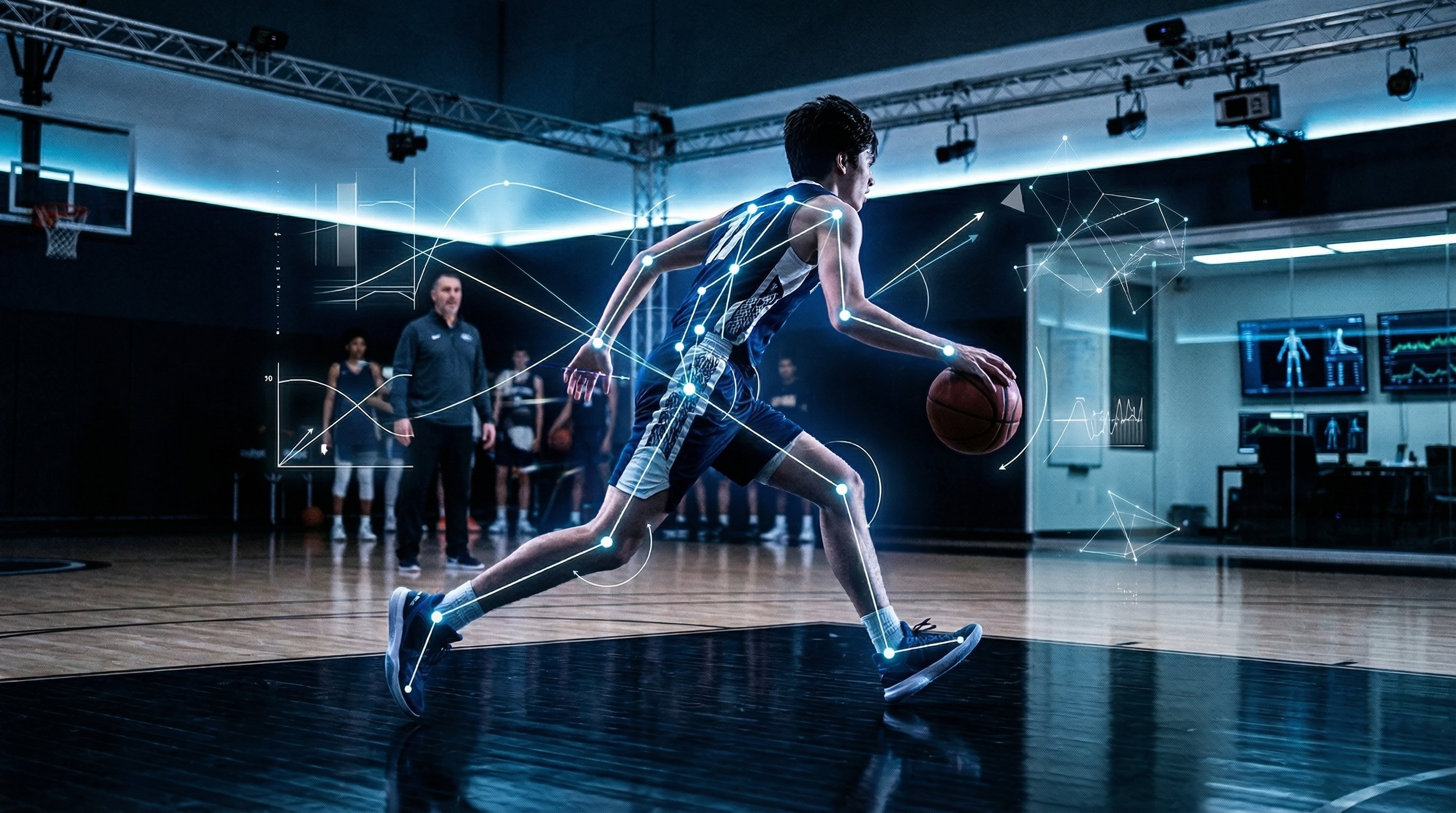
Consider a subtle application: player rotation sensing. In soccer, spacing between players determines play effectiveness. Today, broadcasting shows this through graphics—team formation overlays. With proprioceptive feedback, you could feel the positions of all 22 players as a spatial model in your own body—muscle-position feedback conveying team shape directly to your motor cortex. You don't see the formation. You sense it.
A more speculative but technically feasible example: predictive motor feedback. Research at Stanford University and the University College London on predictive coding in the motor cortex shows that brains process motion through prediction, not observation. An AI system trained on thousands of games could predict the precise motion a quarterback will execute on a given play setup—and transmit that prediction to your motor cortex microseconds before execution. You'd see and feel the play before it physically happens. The neural interface decodes your anticipatory motor response and amplifies it. You don't just watch a great throw. You feel yourself making it.
Importantly, this requires voluntary opt-in at every level. Neural interfaces that manipulate motor response without consent would violate bodily autonomy and may be classified as assault. The threshold for ethical neural sports interfaces is explicit, informed, revocable consent on every feature.
Could AI predict your favorite moments before they happen and customize the experience in real time?
Yes. AI trained on individual neural signatures—captured through fMRI studies or wearable neural sensors—could predict engagement spikes 500-1000 milliseconds before they occur and adaptively render the experience to match.
Every brain has structural and functional differences in how it processes sports. Peer-reviewed fMRI studies in the neuroscience literature document that fans watching the same game exhibit different patterns of neural activity depending on team loyalty, sport familiarity, and individual engagement triggers — findings that extend broader predictive coding research from Stanford University and University College London. One viewer's brain lights up during defensive plays. Another's during highlight-reel offense. A third focuses on individual athlete performance over team dynamics.
Fast-forward to 2050: A new sports viewer completes a neural profile—either through a single fMRI session or through weeks of wearable neural sensors tracking their responses to games. The profile captures their neural "engagement signature"—the specific combination of player position, game state, and moment-in-time that triggers highest neural arousal. An AI system trained on millions of historical games learns what moments match that signature.
Then, while watching a live game in immersive format with optional neural feedback, the system can predict with reasonable accuracy which upcoming moments will trigger engagement. Is your signature activated by last-minute defensive stands? When the opponent gets within three points in the final two minutes, the system seamlessly adjusts: increases spatial detail on the defensive line, amplifies ambient crowd audio, boosts the neural proprioceptive signal. You don't consciously notice. The experience adapts to psychological fit.
The implications are both exciting and unsettling. Exciting because personalization could make games feel individually tailored. Unsettling because this level of neural-targeted curation is one step away from psychological manipulation. A platform that knows your neural weak points could theoretically design moments to trigger compulsive rewatching, sports betting, or merchandise purchase.
What happens to the traditional broadcast if immersive and neural interfaces become standard?
Traditional broadcasts would become a legacy format — preserved by older demographics, social venues, and accessibility needs while most viewers shift to immersive.
Today, television captures roughly 125 million viewers per major sporting event in North America. If immersive interfaces became standard—say, by 2045—what does a Super Bowl viewer base look like? Speculative but plausible: 60-70 million viewers in immersive formats. 30-40 million in legacy broadcast (social viewing, bars, older demographics, accessibility reasons). 10-15 million in neural-augmented immersive (high cost, specialized implementation).
What's lost is the unifying broadcast. Everyone watches the same Director's Cut. You all see the same camera angle, hear the same commentary. That creates a common cultural artifact. An immersive Super Bowl fractures that: each viewer experiences a unique environment, potentially unique curation. You might miss a famous angle someone else saw. That's different, not necessarily worse.
The production model inverts. Today, a broadcast requires producers, editors, commentators, graphic designers. Tomorrow's immersive game requires engineers, environment designers, data architects, and neural feedback specialists. Jobs shift, not disappear. The expertise changes.
Who decides what a personalized neural sports experience actually looks like?
Leagues, platforms, neuroscientists, and regulators will negotiate this together—with unsettled questions about manipulation, addiction, equity, and bodily autonomy determining the practical boundaries.
The technical layer is simple: neural interfaces exist, immersive environments render perfectly, and personalization algorithms work. The hard layer is governance. Once you can make sports compulsively engaging at a neural level, you have a responsibility to avoid it. NIH research on behavioral addiction and algorithmic media design shows that platforms optimizing for engagement often cross into manipulation that resembles substance addiction. Sports betting is already showing this pattern: real-time stats feeds and hyper-personalized betting prompts correlate with spiking compulsive betting disorders.
A regulatory framework for neural sports will likely emerge between 2035 and 2045. The EU already requires algorithmic transparency in the Digital Services Act. A neural equivalent might require: (1) explicit user consent before neural feedback is activated, (2) "neural firewall" restrictions preventing platforms from targeting engagement centers of the brain to maximize screen time, (3) mandatory cooling-off periods after sustained neural immersion, and (4) open data access allowing independent neuroscientists to audit whether platforms are designed to be addictive.
Leagues will want to monetize personalization: premium tiers for neural access, per-game subscriptions, exclusive first-person athlete perspectives. But if neural personalization is too aggressive, antitrust regulators might step in. The NFL can't be allowed to optimize a neural sports experience specifically to trigger compulsive viewing if it harms millions of people—even if it's technically superior.
The most likely outcome is a restricted ecosystem: neural sports available through regulated platforms under strict ethical guidelines, with mandatory disclosures of how the experience is being personalized and why. Not perfect. Not risk-free. But a necessary compromise between innovation and protection.
| Interface Layer | Current (2026) | Near-Term (2035) | Far-Term (2050) | Data Delivery Method |
|---|---|---|---|---|
| Display | 2D TV / Phone Screen | Spatial headset (4K per eye) | Neural direct-to-brain + spatial backup | Ethernet → WiFi → Neural implant |
| Perspective Control | Producer-selected camera angles | User-chosen viewpoint in 360° arena | Real-time multi-perspective with AI guidance | Visual field rendering + proprioceptive cues |
| Audio | Stereo (left/right) | 3D spatial audio (surround) | Acoustic neural encoding (actual sound positions derived from game physics) | Spatial mapping → auditory cortex |
| Personalization | Generic broadcast to millions | Algorithm selects highlights, pace, replays | Neural signature prediction + adaptive real-time curation | fMRI-derived engagement profile → in-game optimization |
| Interactivity | None (passive viewing) | Choose camera, camera, access stats on-demand | Real-time proprioceptive feedback (feel player positions, game state) | Motor cortex neural feedback channels |
| Cost Per Game | $15-25 (PPV average) | $20-40 (immersive tier) | $30-80 (neural tier) + regulatory compliance markup | Infrastructure: compute + neural hardware + neuroscientist oversight |
| Technology Company / Research Program | Neural Interface Capability | Current Status (2026) | Projected 2050 Role in Sports |
|---|---|---|---|
| Neuralink | Surgical brain implants achieving 1000+ channel recording | Early human trials (paralysis applications) | High-bandwidth option for prosthesis users and willing early adopters |
| DARPA N3 | Non-invasive neural interfaces (10-100 Mbps bandwidth) | Prototype development phase; multiple contractors | Mass-market consumer neural sports interface (headset-based, no surgery) |
| Apple Vision Pro | Spatial computing (4K per eye, eye tracking, hand tracking) | Consumer product available now | Immersive sports (visual + spatial audio layer) by 2030-2035 |
| Meta Quest Platform | Mixed reality with passthrough + spatial audio | Mass-market device (30M+ users), immersive sports pilots ongoing | Mainstream immersive sports delivery platform for 2035-2045 |
| MIT Media Lab / Neural Encoding Projects | Non-invasive neural decoding via wearable sensors | Research phase; feasibility studies ongoing | Wearable neural profile calibration for sports personalization |
The three layers that must align for 2050 immersive sports to materialize
Three requirements must be simultaneously satisfied for this vision to become reality—not just possibility. None are guaranteed.
Layer 1: Hardware maturity. Spatial displays will be cheap and ubiquitous by 2050. That's highly likely—mobile VR from 2016 to 2024 has proven trajectory. Neural interfaces are the question mark. DARPA's N3 program has publicly stated a goal of non-invasive interfaces by the early 2030s. That timeline extends to 2045-2050 for consumer-grade products. It's plausible but not certain. A major technical barrier or privacy backlash could delay neural interfaces by a decade. Without them, sports stays immersive but not neural.
Layer 2: Rights aggregation and simplification. Today, sports broadcasting rights are fractured across dozens of platforms and regions. For immersive/neural sports to scale, a single entity needs enough leverage to unify rights—or leagues need to own distribution directly. The 2030-2035 media rights cycle (NFL, NBA, MLB all renegotiating) will determine this. If one platform (e.g., Apple or Meta or a streaming newcomer) acquires near-total sports rights, immersive integration becomes feasible. If rights stay fragmented, immersive sports will be isolated pilot projects, never mainstream.
Layer 3: Regulatory permission. By 2045, neuro-ethics will be a major regulatory domain. Governments will have already seen what addictive social media does to mental health—now imagine neural-targeted sports. The regulatory environment around neural interfaces for entertainment will either be permissive (light-touch oversight) or restrictive (heavy guardrails preventing widespread deployment). Sports organizations won't risk billions in neural tech if regulators decide it's unethical. That negotiation happens 2035-2040. The outcome determines deployment speed.
Each layer independently is achievable. Together, they define whether 2050 looks like immersive-neural sports as standard or immersive-only with neural as a curiosity for the wealthy.
What's next
Data collection, AI broadcast production, and neural immersion trace sports viewing's 25-year arc. What remains is whether regulators allow it safely.
This series has traced a 25-year arc: data collection (Part 1), broadcast production (Part 2), and immersive experience (Part 3). Each step moved information from the stadium to the viewer. Part 3 is the logical endpoint—the viewer is no longer receiving a broadcast. The viewer is inside the information.
The question isn't whether technology will allow this. It will. The question is whether sports organizations and regulators allow it to happen safely. That's a cultural negotiation, not an engineering one. And that negotiation starts now.
Sources
- Apple Newsroom — Vision Pro specifications and immersive video capabilities
- Meta — Quest 3 mixed reality sports platform and broadcast partnerships
- DARPA N3 Program — Non-invasive neurotechnology for 10-100 Mbps bandwidth applications
- Neuralink — Neural interface technology and current development status
- Neuroscience Research — Predictive Coding in the Motor Cortex (Stanford and UCL)
- NIH Research — Behavioral Addiction and Algorithmic Media Design
- MIT Media Lab — Neural Encoding and Wearable Neural Decoding Projects
Related Articles on Nexairi
Fact-checked by Jim Smart