Key Takeaways
- Amazon Prime Video's "Prime Vision" overlay displays AWS-powered Next Gen Stats, player tracking, and win probability in real time during Thursday Night Football games
- AWS has built machine-learning win probability models for the NFL, MLB, and NHL — updated after every play, pitch, or shot
- Sportradar's automated video highlight system generates clip packages within minutes of live action, without a human editor selecting footage
- Apple TV+'s MLS Season Pass offers multiple camera angles and language feeds, running a live experiment in viewer-chosen sports consumption
- The personalized sports feed — your preferred stats, no commentary you didn't ask for — is technically deployable in 2026; the barrier is commercial rights, not engineering
Part 1 of this series documented the data gap: every NFL, MLB, and NBA game captures millions of precision metrics per play, while broadcast delivers three to five stats to your screen. That gap is real. But the story doesn't stop there.
Something is already changing. A set of AI systems deployed between 2019 and 2026 is starting to move data from the server room to the living room. Not for every fan. Not on every platform. But the structural shift is underway — and understanding what's live now clarifies exactly what the next five years of watching sports will feel like.
What is Amazon's Prime Vision and what does it actually show during NFL games?
Prime Vision is Amazon's alternate broadcast overlay for Thursday Night Football that displays Next Gen Stats, player tracking paths, and win probability — all updated in real time during live play.
When Amazon secured exclusive rights to Thursday Night Football in 2022 at roughly $1 billion per season, according to reporting by The Wall Street Journal, the deal came with a mandate: do something the networks can't. The result was Prime Vision, an alternate viewing experience available on Amazon's Fire TV and Prime Video app.
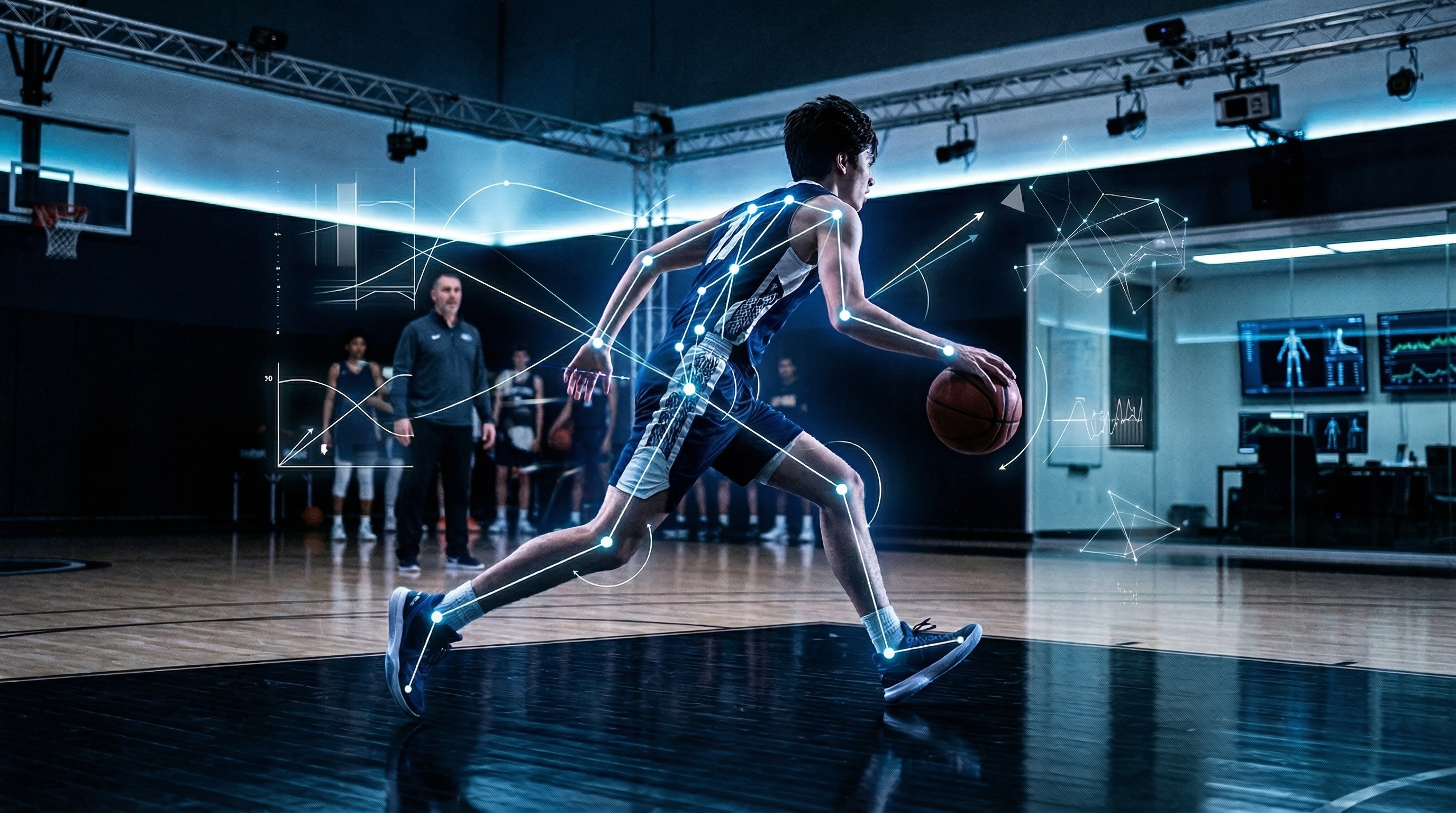
Prime Vision layers data directly onto the live broadcast. When Patrick Mahomes drops back to pass, trailing lines appear on-screen tracing each receiver's route. A heat map shows the defensive formation shifting in real time. A win probability meter — updated after every snap, powered by AWS machine learning — moves as the play unfolds. This isn't a replay feature. It runs live, frame by frame, on top of the game you're watching.
The data source is the NFL's Next Gen Stats infrastructure, which Amazon Web Services documents on its sports analytics page. Zebra RFID chips track all 22 players 25 times per second. That data feeds an AWS cloud pipeline that computes route projections, separation metrics, and win probability in under 200 milliseconds — fast enough to keep pace with a live broadcast.
Prime Vision doesn't replace the main broadcast. It's an opt-in overlay, accessible as an alternate stream. Viewers can switch between the standard broadcast and the data layer at any point. That design choice is intentional: Amazon tested whether fans want more data, not whether they want to replace the traditional broadcast entirely. The answer, based on sustained viewership of the alternate stream through the 2024 season, is that a meaningful segment does.
How do win probability models work in live sports, and who built them?
Win probability models calculate each team's chance of winning based on score, time remaining, field position, and historical outcomes — updated after every play using machine learning trained on years of game data.
Win probability isn't a new concept in analytics. What's new is the real-time deployment at scale. AWS has built win probability models for the NFL, NHL, and MLB, each trained on historical game data and updated in real time during live broadcasts. For the NFL, the model factors in: current score differential, time remaining, down and distance, field position, and team performance data from the current season. After every snap, the model recomputes and pushes an updated probability score.
For baseball, AWS partnered with MLB to build a similar system called the "Statcast Expected Value" engine. When a batter hits a ball with a 108 mph exit velocity at a 28-degree launch angle, the model computes — within two seconds — what percentage of identically hit balls in the Statcast database became home runs, doubles, or outs. The result surfaces as "expected batting average" and "expected slugging" — numbers that tell you whether the play was good or bad independent of how the fielders happened to be positioned that day.
NHL's equivalent is the xGoals model, which the NHL surfaces through its official stats platform. A shot from the slot with a clear lane scores higher than a shot from a poor angle under pressure. The model assigns a goal probability to each shot based on distance, angle, shot type, screen presence, and pre-shot movement. These are no longer analytics blog concepts. They appear on NHL broadcasts and the league's official app during live games.
Can algorithms generate sports highlights without a human editor choosing the clips?
Yes. Sportradar's automated highlight system identifies key moments from live game data and assembles short-form video packages within minutes of real events, without human clip selection.
Sportradar, the Swiss data and media company that operates as the official data partner for the NFL, NBA, NHL, and NASCAR, has built an automated video clip system that connects live play-by-play data to broadcast feeds. The system doesn't watch video. It reads the event stream — play type, outcome, players involved, score context — and flags moments that meet highlight criteria: touchdowns, home runs, game-tying plays, last-minute scores, buzzer beaters.
Once flagged, the system pulls the corresponding video timecodes from the broadcast archive. It trims the clip to a pre-defined window (typically 20-45 seconds around the key moment), applies branding, and makes the package available for distribution — all within five to eight minutes of the live event, according to Sportradar's product documentation. For a 10-inning baseball game, that means a complete highlight reel is ready before the post-game broadcast begins.
Leagues and media companies license this system to automate highlight distribution across social platforms, league apps, and partner sites. The primary use case isn't replacing ESPN's SportsCenter editors — it's speed at the long tail. A regional broadcaster covering 12 games simultaneously can't maintain a human highlight team for each one. Sportradar's automated system handles volume that human production teams can't match cost-effectively.
The AI-powered fan experience goes beyond highlights: real-time push notifications for your favorite player's stats, personalized clip feeds, and in-app highlight reels curated by preference already operate in league apps today.
What is Apple TV+ doing differently with MLS broadcasts?
Apple TV+'s MLS Season Pass offers multiple camera angle feeds, Spanish and English commentary options, and stats-enhanced presentation — moving toward viewer-chosen broadcast formats at full league scale.
In February 2022, Apple and Major League Soccer announced a 10-year broadcast partnership valued at $2.5 billion, per the official Apple Newsroom announcement. Every MLS match — all 510 per season — would air exclusively on Apple TV+ through MLS Season Pass. No blackouts. No local affiliate restrictions. One platform, all games.
The broadcast design was different from day one. MLS Season Pass launched in 2023 with English and Spanish language feeds as standard, not premium options. A dedicated tactical camera angle was available for matches featuring top clubs, giving viewers an elevated wide-angle view designed to show full-field shape and movement rather than ball-following coverage. Stats overlays — powered by Opta, the data division of Stats Perform — display possession percentages, progressive passes, and shot maps during live play.
The significance isn't the features themselves. It's the distribution model. When a single platform owns all games with no cable affiliate conflicts, it can redesign the broadcast format without permission from regional carriers. Apple doesn't need approval from a local cable operator to run a stats overlay. It can push a new camera angle to 50 million subscribers in a single software update. That structural freedom is what allows broadcast experimentation at scale — something legacy TV networks can't replicate without clearing rights across dozens of distribution agreements.
The MLS 2026 season is MLS Season Pass's biggest test yet, with the FIFA World Cup on home soil amplifying North American soccer interest at exactly the moment Apple needs to prove its model works.
What does a truly personalized sports feed look like in 2026?
A personalized sports feed serves the viewer's preferred stats overlay, chosen commentary language, and curated alerts for tracked players — adapting in real time without manual settings adjustments during the event.
The components of a personalized feed exist in isolation right now. Prime Vision shows you tracking data. MLS Season Pass offers camera choice. Sportradar pushes player-specific highlights. The integration — a single platform that knows you follow Jon Rahm and surfaces every shot with full Strokes Gained data the moment the ball stops — doesn't exist yet at scale. But the engineering requirements to build it are met.
Stats Perform's AI platform, called Opta Vision, processes live tracking data across multiple sports and already generates AI-written match reports in multiple languages — published within 60 seconds of final whistle, according to Stats Perform's product documentation. The same data pipeline that writes a match report can power a preference-matched stats overlay. If the platform knows you track rushing yards per attempt rather than total yards, it can surface the right number without you asking.
The technical infrastructure is table-stakes. What's missing is aggregation. Most personalization experiments are platform-siloed: Amazon's data stays in Prime Video, Apple's stays in the Apple ecosystem, MLB's stays in the Statcast app. A viewer who watches NFL games on Amazon and MLB games through the MLB app and NBA games on ESPN gets three separate personalization systems with no shared preference data. Until a league or platform aggregates across sports, the personalization ceiling stays low.
Which platforms have deployed AI broadcast features — and what's still missing?
Amazon, Apple, and the major leagues have deployed real AI-assisted broadcast features since 2019. The consistent gap is cross-platform personalization — every system stays contained to its own app.
| Platform | Sport | AI Feature Deployed | Data Source | Live Since |
|---|---|---|---|---|
| Amazon Prime Vision | NFL (Thursday Night Football) | Player tracking overlay, route visualization, win probability meter | AWS + Zebra RFID (Next Gen Stats) | 2022 |
| ESPN / ABC | NBA | Second Spectrum defensive tracking overlays, spacing metrics, shot quality | Genius Sports (Second Spectrum) | 2019 |
| Apple TV+ / MLS Season Pass | MLS (Soccer) | Multi-angle camera feeds, Spanish/English commentary toggle, live stats overlay | Stats Perform (Opta) | 2023 |
| NHL Network / ESPN | NHL | xGoals shot probability, zone entry tracking, win probability | AWS + NHL PUCK and PLAYER tracking | 2021 |
| MLB.tv / ESPN | MLB | Statcast strike zone graphics, exit velocity, launch angle, expected batting average | AWS + Hawk-Eye (Statcast) | 2017 (full rollout 2020) |
| Sportradar Partners | NFL, NBA, NHL, NASCAR | Automated highlight packages, AI-written play summaries | Sportradar official league data feeds | 2021 (automated clips), 2023 (AI summaries) |
What's the biggest barrier to AI broadcasts becoming standard everywhere?
Media rights fragmentation is the main barrier. Different platforms hold broadcast rights to different sports and leagues, preventing any single service from building a unified AI broadcast experience.
The NFL airs on Amazon, ESPN, Fox, NBC, CBS, and NFL Network simultaneously — each under separate broadcast agreements with different production standards. Amazon can run Prime Vision on its Thursday games. Fox can't replicate it on its Sunday games without negotiating separate data access from the NFL, building independent AWS infrastructure, and getting agreement from its affiliate carriers to support the alternate feed. Those aren't minor logistics. They're multi-year contract negotiations.
Data rights compound the problem. Sportradar's league data agreements govern what data flows to which partners. A broadcaster that doesn't hold official data rights can't legally power an AI overlay with player tracking data — even if the technical system to do so exists. Official data partnerships require separate licensing agreements with each league, and leagues have financial incentives to keep premium data tightly controlled. Teams pay $2-5 million per year for access to tracking dashboards that broadcasters can't show you without a separate licensing agreement.
So the future of AI broadcasting isn't held back by sensors or cloud infrastructure. It's held back by a rights ecosystem built for a world where content is scarce and distribution is controlled. That's the same rights structure that's been fragmenting sports viewing for 40 years. AI doesn't dissolve it. It just makes the fragmentation more visible.
The gap is closing — but not evenly
The data infrastructure that Part 1 described — hidden, precise, nearly unused in broadcasts — is no longer entirely hidden. Six years of AI broadcast experiments have moved measurable amounts of that data stream toward the viewer. Win probability is live. Player tracking is visible. Automated highlights ship within minutes. Alternate feeds with viewer-chosen angles exist on at least one major platform.
What's coming in the next five years isn't a new infrastructure build. It's integration pressure. As streaming platforms compete for sports rights, the broadcast experience becomes a differentiation lever. Amazon didn't buy Thursday Night Football to air the same product as Fox. Apple didn't sign a 10-year MLS deal to broadcast it like ESPN would. The next rights cycle — NFL, NBA, MLB all renegotiating major deals before 2030 — will accelerate how fast AI features become the standard rather than the alternate stream. The platforms that can show leagues how AI transforms broadcast economics will win those rights. The leagues know it. So do the engineers building the systems.
What remains genuinely uncertain is whether fans will accept the AI-mediated broadcast or push back toward the unfiltered human broadcast. Early Prime Vision viewership numbers suggest the demand exists in a meaningful minority. Whether that minority grows to majority preference remains the central open question — not a technical one, but a cultural one.
What's next
The AI broadcast systems covered here operate within the current screen format — your TV, phone, or tablet. Part 3 of The Future of Sports Viewing leaves the screen behind entirely and examines what sports viewing looks like when the screen is no longer the primary interface: spatial computing, mixed reality, and the post-broadcast environment where the viewer is inside the data, not watching it from a distance.
Sources
- Amazon Web Services — NFL Next Gen Stats infrastructure and Prime Vision analytics
- Amazon Web Services Sports Analytics — win probability models for NFL, MLB, and NHL
- The Wall Street Journal — Amazon Thursday Night Football deal details ($1B/year through 2033)
- Apple Newsroom — MLS Season Pass 10-year partnership announcement ($2.5B)
- Sportradar Media Solutions — automated highlight and AI-generated content documentation
- Stats Perform Opta Vision — AI-generated match reports and real-time tracking data products
- Stats Perform Opta — official data partner for MLS Season Pass
- NHL Official Stats — xGoals and puck/player tracking data
- Genius Sports / Second Spectrum — NBA optical tracking and ESPN broadcast integration
- Baseball Savant / MLB Statcast — expected batting average, expected slugging, and live Statcast data
Related Articles on Nexairi
Fact-checked by Jim Smart