Every business owner thinks they are using AI. ChatGPT got the login. Copilot shows up in Microsoft. The checkbox is checked.
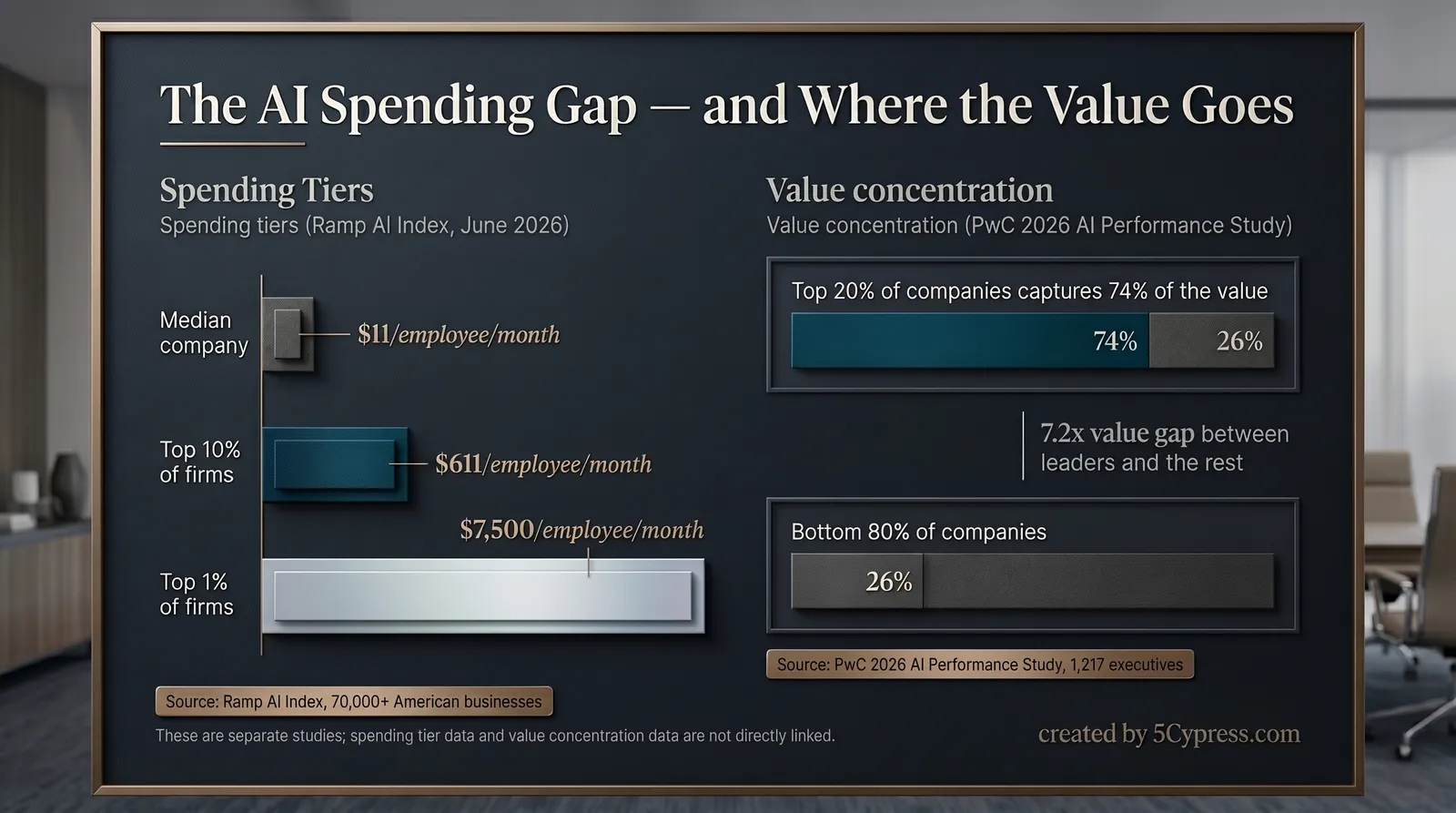
What they don't know is that the top 1% of firms spend $7,500 per employee per month on AI. The median company spends $11. That is a 681x gap in investment. And it is already producing a measurable 7.2x gap in value captured.
A CPA or CFO walking into a client meeting without knowing which tier their client is in is walking in blind.
74% of AI's economic value is captured by just 20% of companies. The gap is not closing. It is widening every quarter.
What the PwC Data Actually Shows
PwC's 2026 AI Performance Study surveyed 1,217 senior executives across 25 sectors. The finding vendors don't advertise: AI's upside is already locked in for a small group of companies.
74% of AI's economic value is captured by just 20% of companies. The other 80% are using AI tools but capturing 26% of the value. This is not a law of nature. It is a design choice.
The top 20% generate 7.2x more value than competitors. Not 20% better. A completely different category. Their profit margins run 4 percentage points higher too. More productive and more profitable at once. The reason for both comes down to one choice: they rebuilt their businesses around AI instead of layering tools on old processes.
Companies that use AI only to cut costs fall behind companies that use it to grow and reinvent. That's why the gap keeps widening. The leaders compound their advantage. The followers watch it happen.
The Ramp Data: What the Spending Gap Looks Like in Practice
The Ramp AI Index measured actual spending across 70,000 American businesses using Ramp's corporate card and bill pay platform.
Median company spend: $11.38 per employee per month on AI tools. That is about $137 per employee per year. Top 10% spend roughly $611 per employee per month. Top 1% — Ramp calls them the "AI-pilled" firms — spend $7,500 per employee per month. A 100-person firm at that level would be investing $9 million per year in AI infrastructure and tools.
The top tier isn't just spending more money. They run the most capable AI tools alongside open-source options. Multiple platforms at once. Spend for the top 1% grew 14.1% per employee in a single month. If that pace holds, the tier doubles its AI investment in under six months.
That's not the profile of a firm that added a ChatGPT seat. That's a firm that rebuilt its operations around AI.
Why the Gap Compounds Instead of Closing
The concentration of AI's value is not a one-time advantage. It is a structural disadvantage that widens every quarter.
When the top 20% rebuild around AI, margin and efficiency gains come fast. They put those gains back into better models, deeper integrations and more AI talent. When a median company layers a tool onto existing work, they get a short-term productivity bump. It levels off. No compound effect. The cycle stops.
Here's what this means for your clients. Their competitive position now depends on how they use AI, not what they make or sell. A competitor that rebuilt around AI will outrun one with better software but no workflow redesign. The gap that opens this quarter doesn't close on its own.
Nexairi Dispatch
Get the next AI move before it turns into a workflow problem.
Join the free newsletter for concise AI news, practical checklists, and the decisions practitioners need to make next.
Free. No spam. Unsubscribe anytime.
The 3-Question Diagnostic for Your Next Client Meeting
You do not need to see their books to know which tier they are in. Three questions, five minutes, and you will know exactly where your clients stand.
Question 1: What are they spending?
Ask them to estimate monthly spend on AI tools and infrastructure. Do not expect a precise answer. The point is the order of magnitude. Are they in the $50-per-month ChatGPT tier? The $5,000-per-month multiple-tools tier? Or the $50,000-plus enterprise transformation tier? This tells you immediately how serious the commitment is.
Question 2: Did they change the workflow or add a tool?
This is the critical distinction. If they bought Copilot and told the team to use it, they layered a tool. If they redesigned the process and then selected the tool to support it, they redesigned. Ask: "When you adopted AI, did your team change how you do the work, or did you add AI into the way you already work?" The honest answer tells you everything.
PwC's data shows that top performers are twice as likely to have redesigned their workflows as their competitors. These are the same firms generating 7.2x more value. The redesign is the common thread. It is the difference between a 7x value multiplier and a one-time productivity bump.
Question 3: Is AI improving their margins or just their headcount?
This is the question that matters most. Ask whether AI freed up capacity that resulted in lower costs, higher prices or more revenue on the same headcount. Or did they just hire faster and keep velocity flat? AI leaders have 4 percentage points higher profit margins. The rest gained productivity without profitability. That gap is how you spot the real leaders.
What This Means for Your Firm
If your clients are in the median $11-per-month tier, they are leaving 7x on the table. Here is what to do about it.
- Use the 3-question diagnostic in your next advisory meeting. Ask it. Write down the answer. It becomes the foundation for a separate "AI positioning" engagement.
- For clients layering tools without redesign: propose a workflow audit. What is the bottleneck? What would you eliminate if you could redesign from scratch? Where does AI solve that constraint? That audit is a billable engagement. It positions you as the person who helps them move from $11 to $611.
- Separate "AI adoption" from "AI positioning." Adoption is tactical. Positioning is strategic. Your margins improve when you are helping clients redesign for competitive advantage, not when you are explaining how to use ChatGPT.
- For clients already spending $600 or more per employee: your role shifts. You are now monitoring their AI ROI, not recommending AI adoption. That is a stickier engagement at a higher margin.
The PwC study tells us that AI's upside comes from how you redesign, not which tool you pick. Good news for advisors. The competitive advantage lives in strategy and execution, not vendor selection. Your clients pay you to see what is coming. They will pay premium fees for help moving from $11 to $7,500. Show them the path.
Related Articles on Nexairi
Sources
Free Assessment
Is your firm ready for AI?
A 5-minute governance check for CPA firms using ChatGPT, Copilot or AI accounting software. Get your score and your top gaps — free.
Jim Smart is the founder and editor in chief of Nexairi. A Business Intelligence Developer with experience building data systems for Verizon, U.S. Army operations, and enterprise finance teams, Jim spent years turning complex data into decisions that executives could act on — dashboards, forecasting models, and automation pipelines across telecom and government contracting. He founded Nexairi to apply that same clarity to AI: making emerging technology understandable and actionable for the operators, accountants, and business owners who need it most. Jim holds GenAI certifications from the University of South Florida Bellini College of AI and completed Springboard's Data Science Career Track.