What launched, and why does the timing matter?
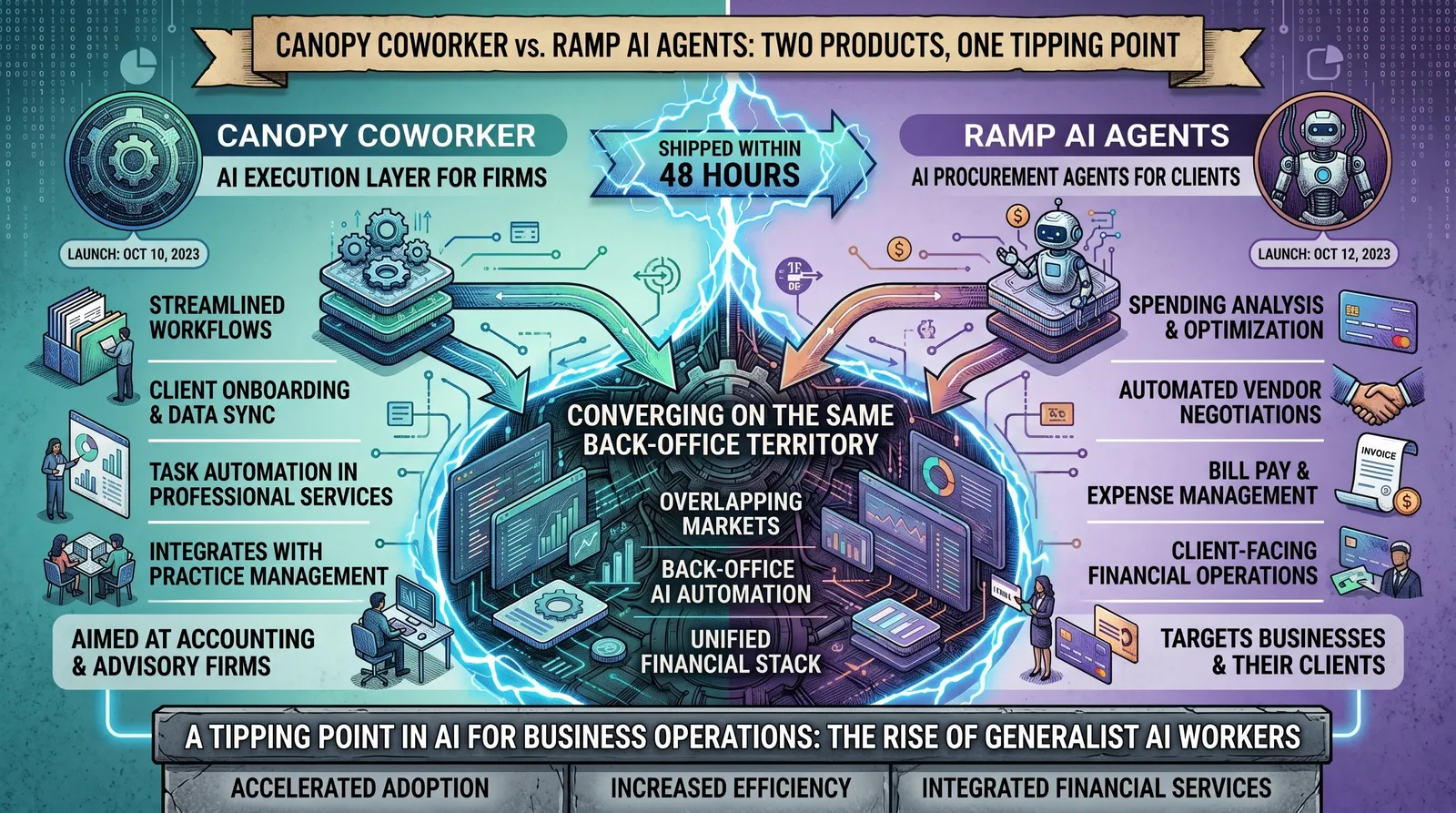
Two separate companies shipped agentic AI products within 48 hours of each other — Ramp on April 29 and Canopy on May 1, 2026.
Timing like that isn't a coincidence. It's a market signal. Accounting and finance automation has moved from research stage to shipping stage, and vendors are racing to own the workflow before competitors do.
The more interesting story isn't either product on its own. It's what happens when you put them on the same map and trace the workflows each one is trying to own.
What does Canopy Coworker actually do for your firm?
Canopy Coworker is an AI execution layer that handles firm coordination — the reminding, routing and chasing that consumes hours without showing up on a bill.
Canopy's SVP of Product Hanna Bjornn put it plainly at launch: "The biggest problem in accounting isn't accounting — it's the work around it. Every firm we talk to loses time and margin to the same thing: chasing, checking, reminding, routing."
Coworker connects to Canopy's existing CRM, document management and billing systems and operates as a supervised AI team member — not a chatbot, not a search tool. It runs complex, multi-step tasks across the full platform.
The capabilities include:
- Autonomous client onboarding — the moment a client is created, Coworker triggers folder creation, questionnaire delivery and welcome sequences without anyone manually starting each step.
- Scope creep detection — it watches billing and communications for engagements where the effective hourly rate is falling, and flags them before the firm loses margin.
- Regulatory deadline cascading — when a deadline shifts or a disaster declaration affects filing dates, Coworker adjusts connected workflows and subtasks across the firm.
- Capacity planning — it reads task complexity and staff skill levels to surface real-time workload visibility and suggest reassignments before burnout shows up on a staffing report.
- Institutional memory — Coworker learns the firm's specific policies and seniority structure and routes work accordingly, rather than defaulting to some generic logic.
One notable design choice: Canopy Coworker lives entirely inside Canopy's secure environment. No outside AI model touches client files. Humans set the outcomes. The AI handles execution and earns more latitude as it learns the firm's habits, but exceptions always go back to a person.
What do Ramp's AI procurement agents do for your clients?
Ramp's AI agents run the full procurement cycle — vendor sourcing, contract review and compliance checks — without manual intervention at each step.
The platform started in corporate card and expense management. The April 29 launch is its move into procurement proper: the workflow that runs from "we need a new software tool" all the way to a paid purchase order. Ramp's CPO Geoff Charles described the goal plainly: "This is the first step toward a fully autonomous back office."
The operational metrics Ramp cites are specific. Customers are saving an average of 16% annually on vendor costs and eliminating 46 hours per month of manual purchasing work. Procurement events that previously took weeks of research and coordination happen, according to Ramp, "in a single conversation."
One detail worth noting for any firm that advises on vendor contracts: Ramp's renewal intelligence flags exactly the kind of contract creep that hurts clients. The company used a real example — an AI contract that started at $39,000 and grew to $500,000 over two years. Ramp's agents deliver a negotiation briefing 90 days before renewal: pricing benchmarks, seat utilization data, user satisfaction signals and flagged contract terms.
The pricing benchmark capability is particularly notable. Ramp runs on transaction data from millions of purchases, so a company with 200 employees enters a vendor negotiation with the same data a Fortune 500 procurement team would use.
How do the two products actually compare?
| Dimension | Canopy Coworker | Ramp AI Procurement Agents |
|---|---|---|
| Who uses it | Accounting firm staff | Finance and operations teams at client companies |
| Primary workflow | Firm coordination — client onboarding, task routing, deadline management | Procurement — vendor sourcing, contract review, purchasing approvals |
| AI model of record | Native to Canopy's secure platform (no external AI access to firm files) | Backed by Ramp's anonymized transaction benchmark data |
| Autonomy level | Supervised — humans define outcomes, AI executes and routes exceptions | Agentic — runs full sourcing events including RFx generation and scoring |
| Reported ROI | Margin recapture through scope creep detection; hours recovered from coordination tasks | 16% average vendor cost savings; 46 hours/month manual work eliminated |
| Launch date | May 1, 2026 | April 29, 2026 |
| Best fit for CPA firms | Firms running on the Canopy practice management platform | Firms that advise clients on procurement strategy or spend management |
Where do these products actually overlap?
On the surface, Canopy and Ramp are solving different problems. Canopy is inside the firm. Ramp is inside the firm's clients. But the boundary is blurring.
Canopy already announced in February 2026 that it's bringing bookkeeping into its practice management platform. Ramp launched an Accounting Agent of its own in February 2026 to streamline bookkeeping. Both products are crawling toward the same territory from opposite directions.
A CPA firm running Canopy handles client coordination internally. A client running Ramp handles procurement and spend management internally. The workflow that's still gray — vendor advisory, contract review as a service, spend benchmarking for clients — is where the two products share a border.
That's an advisory opportunity. Firms that understand both platforms can offer clients a coherent view of their financial operations stack, not just the audit or tax return.
What the simultaneous launch week actually means
When two major accounting and finance software platforms ship AI execution layers in the same 48-hour window, the message isn't about either product. It's about the state of the market. The technical infrastructure for agentic AI in back-office workflows has crossed a threshold — not just good enough to demo, but good enough to ship to paying customers and claim operational metrics.
The race isn't to build an AI tool. It's to become the AI platform that owns the workflow. Canopy wins if firm management runs inside Canopy. Ramp wins if procurement and spend run inside Ramp. Neither company wants to be one tab among many — they want to be the operating system for their respective user base.
For accounting professionals, the practical implication is this: AI adoption decisions are starting to look more like platform bets. The question isn't whether an AI feature works. It's whether the platform that delivers it becomes the hub your practice or your client's finance team depends on every day. Evaluating that question carefully — before a year's worth of institutional memory is locked into a vendor's system — is exactly the kind of judgment AI can't do for you yet.
Sources
Related Articles on Nexairi
Free Assessment
Is your firm ready for AI?
A 5-minute governance check for CPA firms using ChatGPT, Copilot or AI accounting software. Get your score and your top gaps — free.
Curated insights from the NEXAIRI editorial desk, tracking the shifts shaping how we live and work.